Showing posts with label Law. Show all posts

19 February 2014

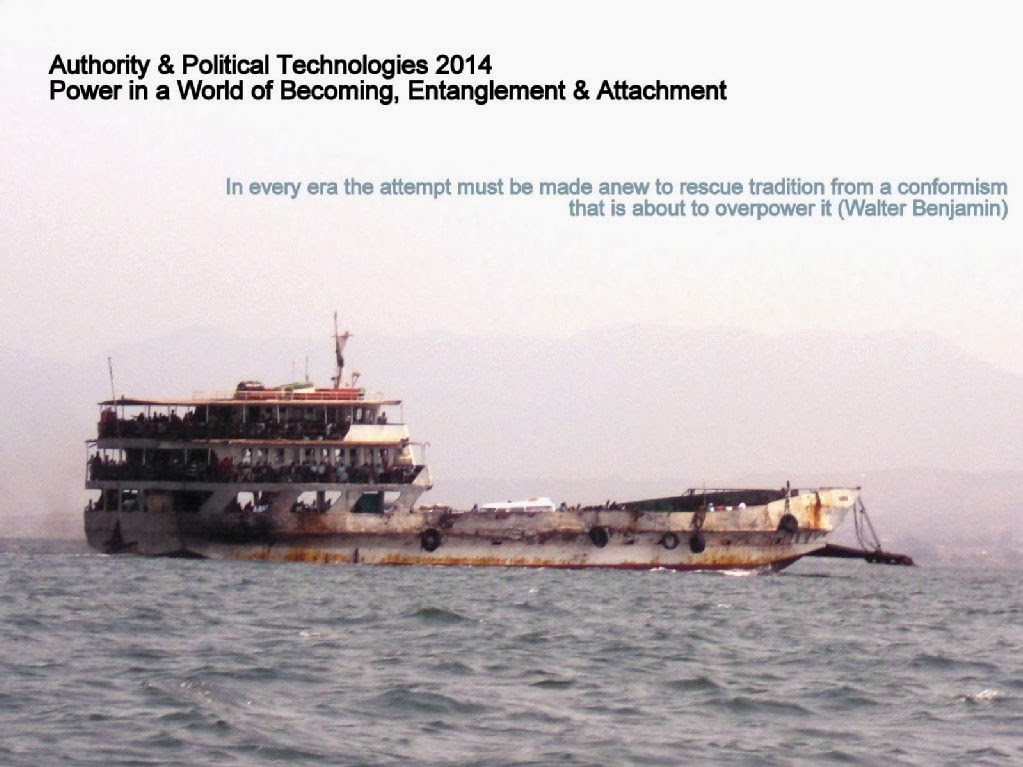
Conference: Authority & Political Technologies 2014, 2-3 June, Warwick

http://www2.warwick.ac.uk/fac/soc/sociology/rsw/authorityandpoliticaltechnologies/apt2014/Recently announced conference event "Authority & Political Technologies 2014: Power in a World of Becoming, Entanglement & Attachment" is aiming for a reinvigoration of post-structuralist theory at its intersection with the social sciences in early June this year at the University of Warwick. The Institute for Advanced Study gives this intriguing statement of intention:
"the issues that post-structuralist theory placed on the critical social science agenda have become more vital than ever - be that the concern for the complex and dispersed nature of power and agency; the imbrication of power and economics with knowledge and science; rethinking the relation between equality and difference; the political/contested/changing nature of embodiment, biology and ecology; or the efforts of states and others to establish and exercise power over life itself. We maintain that now is the time, not to reject post-structuralist perspectives, but to reinvigorate and transform those traditions through empirical and political work that is creatively engaged with current problems."

No less ambitiously, the conference promises a thrillingly line-up of excellent keynote speakers - Louise Armoore, William Connolly, Christian Borch, Costas Douzinas, Amade M'charek, Luciana Parisi and AbdouMaliq Simone - which guarantees provocative discussion on the conference topics from diverse academic perspectives within the humanities.

Abstract submission is open until 10 March, with suggested themes raging from biopolitics and religion to necropolitics and authority. Further information can be found on the conference website along with the online abstract submission form.

24 August 2013

Article: Liz Kinnamon, "London Riots, Living Walls: Questions of Resistance in Late Capitalism"

Street Art vs. Capitalism by Escif in Grottaglie, Italy, 2011
Deleuzian-inspired e-journal Rhizomes dedicates the virtual pages of its most recent 2013 issue (no. 25) to the cultural and political potential of graffiti, where amongst its offerings (varying a little in quality and glowing exaltation of street art's potential) nestles Liz Kinnamon's incisive commentary, "London Riots, Living Walls: Questions of Resistance in Late Capitalism". Critically investigating the revolutionary potential of graffiti and rioting practices as political speech acts, Kinnamon takes two temporally proximate events in 2011 - the street art conference in Atlanta, Living Walls: The City Speaks and the riots across the ocean in the United Kingdom - to explore the loaded question: "In a neoliberal capitalist climate ... where capital is continuously, cannibalistically folding in, what becomes of attempts to find a way out?"

A lucid break-down of the consumerist atmosphere of the UK riots follows, and a surprisingly complementary reading with the officially-sanctioned graffiti happenings staged during the Living Walls conference. Kinnamon paints a sad picture of the blunted and sanitised evolution of these anti-authoritarian practices since the 1970s:
"We are fully planted in a time when resistance is co-opted, folded into capital, and rendered harmless. ... But even before someone trademarks and stamps a slogan from the latest peoples movement onto a t-shirt, many so-called rebellions bear an already-resemblance to the systems they allegedly oppose. The actors in the UK riots and Living Walls utilize and exhibit the same characteristics capitalist governmentality has conditioned in them."
Yet hope is not completely lost: Kinnamon leaves us with some space to salvage these modes of political speech (rioting, graffiti) from their integration into capital through the work of Rei Terada via Michel Foucault's concept of parrhesia. However, the forms which these speech acts adopt, it would seem, will always be precarious and ambivalent at best.

Rhizomes is an open-access journal. All the essays in the current issue are all freely downloadable from their website. Its archive is also worth a lengthy browse; it can be found here.

21 July 2013

Recorded Lecture: Costas Douzinas, "Philosophy and the Right to Revolution"

 
Listen to Costas Douzinas offer a friendly challenge to Slavoj Žižek and Alain Badiou in terms of the right to revolution and its lawfulness in this lecture, "Philosophy and the Right to Revolution" (although bearing the slightly modified name on the Backdoor Broadcasting Company where it is archived), recorded in London during the two-day conference Actuality of the Absolute: Hegel, Our Untimely Contemporary. Deviating from Žižek, who adds a few of his own comments from the audience, Douzinas' self-branded "heretical" politics asserts a reading of Hegel, disobedience and the Athens riots of 2008 (to name a few themes) in order to posit and explore the right to revolution.
 
Douzinas scrolls conceptually through "the normative force of the real" - through which previous law is negated in the face of successful revolution (and the criminal rebellion is found to be always already authorised) - before moving on to a close reading of property and subjectivity within Hegel, revolution and crime as motors for legal adjustment, and the right to socio-political rebellion based on necessity.
"The revolution does not just delete the past, it synchronically creates its own conditions of success. ... Fact and law, revolution and right, are closely intertwined. The time arrow is reversed. In this sense, every rebellion is, and will have been, the exercise to the right of revolution. Right and revolution, instead of being antithetical, are coeval, supporting each other."
Other contributors to the Actuality of the Absolute conference include Žižek and previous BiM Seminar guest Catherine Malabou. Find their and other fascinating presentations archived on the Backdoor Broadcasting Company here.

7 May 2013

Article: Bernard J. Hibbitts, "Coming to Our Senses: Communication and Legal Expression in Performance Cultures"

Bernard J. Hibbitts was arguably well ahead of the legal scholaship curve when he published "Coming to Our Senses: Communication and Legal Expression in Performance Cultures" in the Emory Law Journal (41 (1992): 873-960), and he settled into this theme for the next few years until the currency of cyberspace pulled him into more intense study of the implications of technology upon the law. "Coming to Our Senses", the first of a series of publications devoted to the human senses and the law threw an ambitiously wide net into legal, anthropological and historical fields in order to contrast an American-style written legal culture with semi- or largely non-literate "performance cultures".
 
Perhaps a little outmoded today and a little unwieldy in the separation between performance and non-performance cultures, Hibbitts' article is nonetheless a fascinating tour of the unappreciated interventions of the five human senses upon legal discourse and tradition, as well as their cultural significance outside of contemporary Western legal modes. Framed as a survey loosely following anthropological research methods, Hibbitts looks to Marshall McLuhan and Walter Ong for theoretical purchase alongside a horde of historical scholars.
"In their highest forms of cultural and intellectual exression, speech routinely gives voice to gesture and gesture gives shape to speech: music gives sound to sculpture, while sculptue gives sustance to music. Law is simultaneously heard, seen, and sometimes even felt and savored. Ultimately, the meaning of significant cultural and legal messages resides less in the individual components of communication (although these must be recognized) than in their synthesis, performance."
Hibbitt's article is available online at a dedicated site via the University of Pittsburgh, or as a pdf article as published in the Emory Law Journal from the Social Science Research Network. The BiM blog is indebted to the Sensory Studies website for providing the link to this text.


12 May 2012

Recorded Lecture: Nina Power, "The Spectre of the 'Public': The Ideology of Law and Order"

The Backdoor Broadcasting Company has archived a probing, half-hour talk by Nina Power, presented as part of the Ideology Now Conference at the Birkbeck Institute for the Humanities in London on 28 April 2012. Getting messy in the heavy topics of law and the public in the "creative empiricism" of Britain's politico-legal environment, Power casts an analytical eye upon the legal and lingusitic formulation of the public and the legal subject in light of Britain's past year of riots, protests and "public disturbance".

Her discursive, engaging and conversational presentation begins from the question: "Why don't we know anything about the law?" Reassessing Louis Althusser's descriptions of the law as belonging to both the repressive state apparatus and ideological state apparatuses, and of the figure of the individual as the bourgeois ideological subject, Power examines what happens when the law confronts (or refuses to confront) collective subjects and group activity.

Power's talk teases out two kinds of legally-recognised publics, a disruptive "bad public" and an always silent and absent "good public". It is on behalf of this good public, constantly terrified of the potentially misbehaving mass of the self-organised mob, that the law and judiciary is "endlessly aggrieved". It is also on behalf of this "good public" that the law is obliged to carve out each component individual from the unsanctioned "bad public",  so as to persecute every member as representatives of an unacceptable collective. Power states:

"With the ongoing and perhaps almost complete destruction of the public sphere in the name of privatisation, individualism and competition, we are at the same time confronted with the necessary ghost of the acceptable public, the one invoked by the state in the name of the preservation of order. This is the mute, static public used against the mobile, protesting public."

25 April 2012

Conference: Poetics of Anxiety and Security: the problem of speech and action in our time. Homi Bhabha on Auden and Arendt, London, 27-8 April 2012

In a two-day conference hosted by Birkbeck (University of London) and the Serpentine Gallery on 27-28 April of this year, Homi Bhabha will lead what will no doubt be a challenging and completely absorbing discussion on W. H. Auden's The Age of Anxiety and Hannah Arendt oeuvre.

Due to its popularity, the venue of the conference has been shifted and as a result further places are available for reservation through the Birkbeck website. Kicking off with a performances, readings and a keyote by Homi Bhabha on the evening on the first day, this will be followed by another keynote and a fairly scholarly schedule of speakers on the second day. And, best of all, the event is free of charge.
"participants will investigate ... in particular the links between the works, the relevance of poetry and the wider issue of security. This multi-disciplinary event will include lectures, discussions, screenings, poetry readings and performances to examine essential questions about the relationship between poetry, politics and art."

18 February 2012

Conference: London Conference in Critical Thought 2012, London, 29-30 June 2012


The London Conference in Critical Thought host their inaugural conference on 29-30 June of this year, supported by the Birkbeck Institute for the Humanities. Engaging with the "critical" tradition, the LCCT is especially seeking out those who fall within the fringes and margins of their academic disciplines in the humanities and social sciences to share their work within a collaborative, interdisciplinary setting.

The conference is divided into sixteen streams (and one catchall, "general" stream), which focus on, inter alia, law and culture, objects and time, Deleuze, animality, cosmopolitics, critiquing critical theory and the ethics of radical politics. Further stream descriptions can be found on their website.
"The LCCT aims to provide an opportunity for those who frequently find themselves at the margins of their department or discipline to engage with other scholars who share theoretical approaches and interests. Interdisciplinary and inter-institutional, the conference hopes to foster emergent critical thought and provide new avenues for critically orientated scholarship and collaboration."
Held at Birkbeck College (University of London), the conference is free to all participants. Their call for papers and panels ends on 19 February, so those interested should send in their proposals very soon.

4 February 2012

Book: Michel Serres, Malfeasance

At the beginning of 2011, Stanford University Press published a new addition to the slowly growing body of translated work by Michel Serres - Malfeasance: Appropriation through Pollution?, translated by Anne Marie Feenberg-Dibon.

Bearing strong resonances with earlier texts such as The Parasite and Rome: The Book of Foundations, the pamphlet-length Malfeasance marks his turn towards contemporary considerations of the confluence between ecology (particularly the human production/act of pollution) and property. Serres' irreverent remodelling of ecocriticism involves his signature pirouettes back and forward in time and smooth segues between themes of religion, advertising, waste, tenancy, etymology and innumerable others.  

Malfeasance demands a reassessment of our proprietary claims and the processes which mark ownership of body, space and soul. While often scathing in his critique, Serres pulls his tract back from the brink of wholesale negativity by proposing (ambiguously) utopian possibilities of freedom in the contradistinguished notions of tenancy, dispossession and "dis-appropriation".
"...pollution comes from measurable residues of the work and transformations related to energy, but fundamentally it emanates from our will to appropriate, our desire to conquer and expand the space of our properties."
A four-page excerpt and the table of contents are available from the first chapter of the text are available from the Stanford University Press website.

18 October 2011

Conference: Being In-Human: The Critical Theory and Law of Human Rights, London, 17-20 November 2011

 
Anyone fortunate enough to be within the greater London area mid-next month may be interested in attending the conference "Being In-Human: The Critical Theory and Law of Human Rights" hosted by Birkbeck Law School. The three-day conference (17 -19 November) is £70 / £35 for students and sports an incredibly exciting lineup of speakers including

"Slavoj Žižek, Chantal Mouffe, Samuel Moyn, John Milbank, Upendra Baxi, Pheng Cheah, Walter Mignolo, Costas Douzinas, Conor Gearty, Bruce Robbins, Paul Patton, Paul Gilroy amongst others"

A provisional programme is available as a pdf from here. To close the event, Birkbeck is also organising a public lecture on 20 November given by Slavoj Žižek and Costas Douzinas, the details of which are accessible through the conference webpage or on facebook.