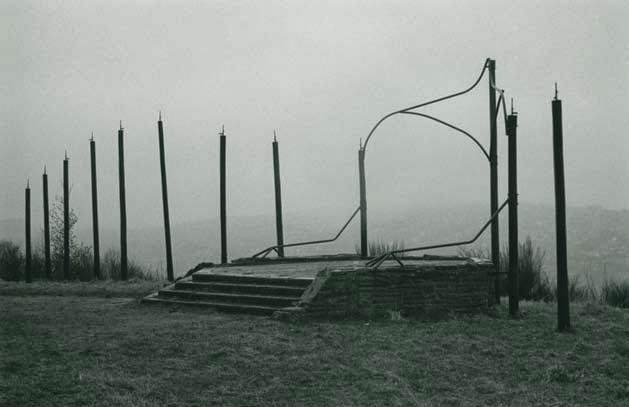
"When I started out on this project I thought I'd be writing about the absence of the excavated matter, but the more I have searched for and peered into these 'holes' the more I have realised that what has happened here is the moving around of matter - across local space, across form and through time. Nothing has disappeared, it has just changed state or location."Written in a self-identified psychogeographic style, Bennet and Hock's piece reads like a memoir replete with haunting images of space and memory. It includes, in the last handful of pages, a back-and-forth Q&A-style dialogue between Bennett and Hock ruminating on their different styles of approach to the project. The "'coffee-table' art book" can be downloaded as a pdf from here.
30 January 2014
Book: Luke Bennett and Katja Hock, Scree
7 September 2013
Exhibition & Events: The Old Operating Theatre Museum and Herb Garret, London
Like that museum, the Old Operating Theatre Museum and Herb Garret also hosts a packed schedule of lectures and events on a variety of medicine-related topics, including the history of pathology, after-death photography and the operated body in film and literature. A detailed list of their events for the next two months can be found on the museum website, along with detailed histories of St Thomas's, Guy's and Evelina Children's Hospitals in London, resources for the history of medicine, a digital catalogue of the objects on display at the museum, and more.
Thanks go to the blog post on Penny Dreadful Delights for giving us the opportunity to know about this obscure but special space.
26 July 2013
Conference: A Feeling for Things - Jane Bennett, 4-5 October, London
another fantastic two-day event in early October, "A Feeling for Things: A Conversation around the work of Jane Bennett". The evening of 4 October will feature a public lecture by Jane Bennett, some of whose work we have already featured on this blog here and here. This will be followed by a full-day workshop on 5 October. Drawing upon academics from a variety of backgrounds - Eileen Joy, João Florêncio, Jussi Parikka, Nigel Clark, Milla Tiainen, Lisa Baraitser and Michael O’Rourke - the event promises to be both a fascinating conversation between politics and philosophy, and a likely crowd-puller.
The public lecture will offer insight into Bennett's current research. The workshop on 5 October seeks to investigate the possible resonances and feedback between the politics of Bennett's work and a variety of other disciplines:
"This two day event makes the writing of Jane Bennett a vibrant matter for discussion across the fields of philosophy, psychosocial studies, political theory, cultural studies, literary theory, visual theory and performance studies among others. In particular, the focus will be on how Bennett’s explorations of vitalism, anthropocentrism, agency, biopolitics and new materialisms contribute to the emerging and fraught conversations between feminist and queer theory, Object Oriented Ontology and Speculative Realism."Registration to the workshop on 5 October costs £20 for students and Birkbeck staff, £40 for all other attendees, with attendance at the public lecture mandatory for all workshop participants. Links to registration are provided on the event webpage. The public lecture on 4 October is free but booking is required - registration to this is handled through Eventbrite.
27 March 2013
Performance & Exhibition: Ruth Clinton, Niamh Moriarty, Michael O'Rourke & Jeffrey Jerome Cohen, Rotator
Pallas Projects in Dublin city currently contains the collaborative exhibition by artists Ruth Clinton & Niamh Moriarty. The show, aptly coined with the palindrome Rotator, loops around secrets, crypts, water and topographies in a variety of media forms; it explores the lesser-known currents of one of the city's more familiar waterways (the River Poddle), records endless passageways of/in brick, and commemorates the hidden stories of the underground.
Audio of the tour can be found here. The exhibition catalogue is downloadable here. Further pictures and descriptions of the exhibition can be found in the artists' blog posts, Ruth Clinton and Niamh Moriarty as well as the Pallas Projects website, where may also be downloaded an information sheet related to Rotator and a podcast interview with the artists recorded by RTE Lyric FM."Rotator is more attuned to the inclinations and glossolalic streaming together of matter. The exhibition is an exercise in diverculvertation as we drift from territories of the infinitesimally small - our selves and bodily matter composed mostly of water - to the infinitely vast - rivers, seas, oceans, the sky, moon and stars."
17 November 2012
Conference: Body Projects Conference, 9 March 2013, York

"It has been claimed that the unaltered female body is an unacceptable entity in the contemporary west and that the female body physically bears the marks of contemporary culture through the modification enacted upon it. The body is part of the embodied experience of an individual, but also, and increasingly, an object for critique."
23 September 2012
Recorded Lecture: Jane Bennett, "Powers of the Hoard: Notes on Material Agency"
![]() |
| The Great Pacific Garbage Patch |
If Vibrant Matter proffered the rough layout or skeleton of such a concept, Bennett's talk, "Powers of the Hoard: Notes on Material Agency", begins a process of enfleshment, building some theoretical muscle on top of that bone. Continuing her project of "thing-power" through a distinctly vital materialist lens, her discussion in this presentation at the Imperial War Museum in London on 3 December 2010 asks the crucial question of what kind of lexicon is available to us to acknowledge and explore the active power of things when language itself tends towards anthropocentrism and instrumentalist positionings.
Propensity, action, trajectory, vital impetus, assemblage - Bennett cycles through a host of possible vocabularies before fixing on the concept of the hoarder. The various attitudes towards objects demonstrated by "extreme" hoarders on the A&E reality television show Hoarders, she argues, gesture towards the intercorporeality of things and humans within the amasser's environment. In such a perception, the self is both porous and aggregate, itself a collection of a vast number of attendant things.
"A vibrant materialist would say that hoarders have exceptionally acute awareness to the extent to which all bodies are intertwined with those in its vicinity. They sense that a variety of 'its' make up a self and that the 'its' possess a vibrancy formerly thought to be unique to organic bodies."Bennett's talk in London has been archived on the Backdoor Broadcasting Company website and can be streamed or downloaded from here, along with slideshows from her presentation. You can also track the evolution of this project of lexical accretion by listening to or viewing her other talks on the topic at ICI Berlin in May 2011 and at The New School on 13 September 2011.
14 June 2012
Exhibition: "Invisible: Art about the Unseen, 1957-2012", 12 June - 5 August, London
The Haward Gallery at the Southbank Centre in London has now launched its new exhibition, Invisible: Art about the Unseen, 1957-2012. Collecting together samples of art exploring ideas related to the invisible and the hidden, from productions by well-known twentieth-century artists to contemporary works."Invisible ultimately reveals that there is no limit to the possible meanings of invisibility in art. Works that share a similar blankness can convey remarkably varied content. An empty room or unoccupied plinth may function as a sign of mystical sensibility, a haunting past, or a cursed presence. ... And almost inevitably most of these works highlight the fact that our interpretation and experience of art is often contingent on information that exists apart from an object itself."
23 March 2012
Article: Julia Reinhard Lupton, "Thinking with Things: Hannah Woolley to Hannah Arendt"
Just for this month, postmedieval: a journal of medieval cultural studies is offering the the whole content of their newest issue of Spring 2012 - entitled "Becoming Media", edited by Jen Boyle and Martin Foys" - for free download. Contributions include Eugene Thacker's "Wayless Abyss: Mysticism, Mediation and Divine Nothingness" and a fascinating cross-media experiment by Whitney Anne Trettien, "Plant
Animal
Book: Magnifying a Microhistory of Media Circuits", which is accompanied by an additional digital essay-cum-gloss to be read relationally with the postmedieval text."Bringing the two Hannahs to the same table helps me unfold the preparation of meals as engaging at once a worldly environment and social scripts, setting the scenes in which action, work and labor enter into the most intimate proximity, without, however, losing their distinctions altogether."
18 February 2012
Conference: London Conference in Critical Thought 2012, London, 29-30 June 2012
The London Conference in Critical Thought host their inaugural conference on 29-30 June of this year, supported by the Birkbeck Institute for the Humanities. Engaging with the "critical" tradition, the LCCT is especially seeking out those who fall within the fringes and margins of their academic disciplines in the humanities and social sciences to share their work within a collaborative, interdisciplinary setting.
The conference is divided into sixteen streams (and one catchall, "general" stream), which focus on, inter alia, law and culture, objects and time, Deleuze, animality, cosmopolitics, critiquing critical theory and the ethics of radical politics. Further stream descriptions can be found on their website.
"The LCCT aims to provide an opportunity for those who frequently find themselves at the margins of their department or discipline to engage with other scholars who share theoretical approaches and interests. Interdisciplinary and inter-institutional, the conference hopes to foster emergent critical thought and provide new avenues for critically orientated scholarship and collaboration."Held at Birkbeck College (University of London), the conference is free to all participants. Their call for papers and panels ends on 19 February, so those interested should send in their proposals very soon.
20 September 2011
Recorded Lecture: Jeffrey Jerome Cohen, "Feeling Stone"
Cohen describes the relation he seeks as a collaboratory of "experimenting, working and living together" between the agency of stone and the excitation of humans, in which the meeting with rock can destabilise a human-centric narrative of existence and give way to different, creative rethinking of ecologies, landscapes, texts and art. In the process of this reconceptualisation, he subtly weaves together the actor network theory of Bruno Latour with Graham Harman and Tim Morton's work on object oriented ontology and echoes of Jane Bennett's vibrant materialism (the last of which he engages with directly in the final section of his lecture) along with a liberal dose of Gilles Deleuze and Félix Guattari.
The recording of his lecture is available online, along with an image capture file of Cohen's accompanying slideshow.
"Stone as monument is stone in movement, and by 'movement', I mean 'motion' that brings about connection that is desire, affect. But the question arises, where does that motion originate – from the human hands that perhaps fashion the monument, or from the stone itself?"
17 July 2011
Recorded Lecture: William E. Connolly, "Two Images of Becoming: Whitehead, Nietzsche, and Cosmopolitics"
"In a fragile world of multiple attractions and repulsions that exceed our everyday practices of action-oriented perception (the Bergsonian distinction), we need to work upon ourselves to become more responsive: to the artistry of whales who compose music as they travel, to the complexity of bird powers of sonar navigation and migration .. to yeast as the vibrations it emits express unconscious feelings of pain when alcohol is poured on it."
The three panel talks from the conference - divided into the themes "Agency and Master", "The Ethical Sensibility of William E. Connolly" and "Immanence, Transcendence, Becoming" - are also available for online streaming and download.
26 April 2011
Web: Biothing: Repository of Computational Design

Effervescent, undulating and curiously sonorous, the visuals created and displayed on biothing.org, primarily led by Alisa Andrasek ("experimental practitioner and research based educator of architecture and computational processes in design"), seem to span multiple gaps in the aesthetics of structure - abstract and concrete, biological and machinated, randomness and repetition, stasis and movement. Offering poetically proliferating architectures to experience and inhabit, Biothing/CONTINUUM research explores the question of where genetic growth, patterning and curvature intersects with the linearity of diagrammatics and computational replication in order to affect the ways in which forms and space are experienced.
The Biothing research archived online exhibits a rare combination of programming, textuality and visual expression based (importantly) in lived environments. As such, the functional and often in-situ element of each project provides fascinating interpretations of theory-meets-practice. Biothing projects include a critical rethinking of the rigid organisation of city-centre buildings, expanding the possibilities of sound composition software by introducing algorithmically based processes and producing new lightscapes to stimulate novel fields of perception of aquatic spaces.
"biothing/CONTINUUM research is exploring the shift from the technique-based approach that dominated generative practices within architecture in the recent past towards the more explicit computational approach by engaging with scripting directly in an open source manner - addressing a growing culture of collective computational knowledge emerging within a discipline. At the core of the work is an accumulative library of scripts and methods for their transcoding, applicable to the constraints of materials, structure, fabrication and assembly. Evolving algorithmic infrastructure allows a designer to work at the scale of information linked to various forms of materialization. Computational patterns are understood as deep in terms of their potential to produce expressions at various scales."
10 April 2011
Book: Jane Bennett, Vibrant Matter
This relatively new 2010 publication (Duke University Press) sees Jane Bennett critically extend the work of her earlier book, The Enchantments of Modern Life: Attachments, Crossings, Ethics (2001) into the interrogation of “thing-power” through the formation of a vital materialist perspective. Bennett's anecdotal style finds a fitting model to poetically introduce the strange intimacy of her subject matter while simultaneously understating the ambitious trajectory of her text, which seeks to displace so many entrenched discourses surrounding issues such as the ontology of objects and matter, consumption, environmental politics and democracy.
Following, as Bennett herself identifies, “in the tradition of Democritus-Epicurus-Spinoza-Diderot-Deleuze” (xiii) (most especially Deleuze), Vibrant Matter segues from a meditation on the vitality of an ordinary gathering of items by a storm-drain grate - a work glove, oak pollen, a dead rat, a plastic bottle cap, a stick - to an ultimate consideration of the possibilities of forming a different kind of ethics premised on assemblages comprising of both human and non-human affective relations, and a different kind of agency which takes into account the powerful actant capabilities of "inanimate" matter.
"The aim is to articulate the elusive idea of a materiality that is itself heterogeneous, itself a differential of intensities, itself a life. In this strange, vital materialism, there is no point of pure stillness, no indivisible atom that is not itself aquiver with virtual force." (57)


.jpg)