Showing posts with label Architecture. Show all posts

9 February 2014

Article: Tyler Coburn, "Charter Citizen"

http://www.e-flux.com/journal/charter-citizen

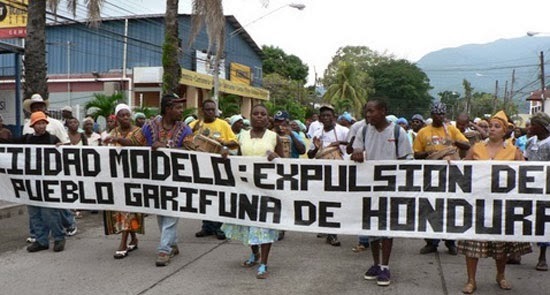
A new edition of e-flux, hot off the digital presses, hits us with some juicy morsels this month, including this text by Tyler Coburn, "Charter Citizen". Coburn tests the temperature of a recently ended radical libertarian venture - the establishment of autonomous cities within host country Honduras' borders - in order to reconceive capitalism anew.

"Charter Cities", Coburn explains, build off economist Paul Romer's theory that sets of carefully considered rules encourages economic growth, investment and innovation; and that introducing such "good rules" into a zone with weaker ones would encourage further economic and financial advancement within the host state, in investment, labour force and civil and political structures. But Coburn notes that the dominant and fundamental mode of political engagement at the grassroots level becomes movement - voluntary migration (both in and out) becomes political, democracy conditional and citizenship privatised; at an international level it becomes dependent on tenuously balanced comity and contract.
"Whether floating in international waters or sprouting on foreign territory, these proposed cities are the proving grounds for the technolibertarians’ foray into governance. In fact, they already demonstrate a concrete link between technology and geopolitics: venture capitalist Peter Thiel donated the same amount of startup funds to [charter city venture] the Seasteading Institute as to Facebook."
Also in this month's edition of e-flux online, available to non-subscribers, is a recent instalment by Reza Negarestani, whose work "Differential Cruelty" we spotlighted on BiM. Find these articles on the e-flux journal online.

30 January 2014

Book: Luke Bennett and Katja Hock, Scree


http://lukebennett13.wordpress.com/2013/11/11/scree-is-here/
 
In the tail end of 2013, Luke Bennett and Katja Hock released their collaborative effort Scree, currently available for download from Bennett's blog. Launching from an enquiry into an ordinary house brick sheltered in his garage, the pursuit to take it "back to the place of its birth" carry Bennett to peculiar wasteland places layered together in an accumulating escarpment: landfill, abandoned skiers' dry slope, forgotten gas works, ghost town and more.
"When I started out on this project I thought I'd be writing about the absence of the excavated matter, but the more I have searched for and peered into these 'holes' the more I have realised that what has happened here is the moving around of matter - across local space, across form and through time. Nothing has disappeared, it has just changed state or location."
Written in a self-identified psychogeographic style, Bennet and Hock's piece reads like a memoir replete with haunting images of space and memory. It includes, in the last handful of pages, a back-and-forth Q&A-style dialogue between Bennett and Hock ruminating on their different styles of approach to the project. The "'coffee-table' art book" can be downloaded as a pdf from here.

27 March 2013

Performance & Exhibition: Ruth Clinton, Niamh Moriarty, Michael O'Rourke & Jeffrey Jerome Cohen, Rotator

Pallas Projects in Dublin city currently contains the collaborative exhibition by artists Ruth Clinton & Niamh Moriarty. The show, aptly coined with the palindrome Rotator, loops around secrets, crypts, water and topographies in a variety of media forms; it explores the lesser-known currents of one of the city's more familiar waterways (the River Poddle), records endless passageways of/in brick, and commemorates the hidden stories of the underground.
 
The rich textures of Clinton and Moriarty's exhibition - dizzingly wet, mossy and stony - are sensationally enlivened in a recorded "tour" of the exhibition performed by the artists themselves, Michael O'Rourke and Jeffrey Jerome Cohen (read by fellow artist John Ryan) on a wintery March evening. Beginning with an introduction by O'Rourke, the tour takes the form of a question-and-answer conversation between the participants inflected by the exhibition works. "Hydrocryptographic", O'Rourke describes Rotator, and the four performers draw upon Serres, Cixous, Derrida, myths of the giant Balor, Blake, T.S. Eliot and a particuarly savvy twenty-questions AI algorithm to trace the damp crevasses of the show within this 45 minute audio recording.
 
Audio of the tour can be found here. The exhibition catalogue is downloadable here. Further pictures and descriptions of the exhibition can be found in the artists' blog posts, Ruth Clinton and Niamh Moriarty as well as the Pallas Projects website, where may also be downloaded an information sheet related to Rotator and a podcast interview with the artists recorded by RTE Lyric FM.
"Rotator is more attuned to the inclinations and glossolalic streaming together of matter. The exhibition is an exercise in diverculvertation as we drift from territories of the infinitesimally small - our selves and bodily matter composed mostly of water - to the infinitely vast - rivers, seas, oceans, the sky, moon and stars."

21 March 2012

Conference: Space and Flows: Third International Conference on Urban and ExtraUrban Studies, Detroit, 11-12 October 2012

Wayne State University in Detroit looks towards urban organisation of all kinds at the Third International Conference on Urban and ExtraUrban Studies in October of this year. Targeting the specific (but fairly broad) theme of "Transforming Cities and Communities in Contemporary Times", the conference explores two central issues: firstly, what are the new and emerging spaces of production, consumption, and human living (as human created products) as communities, regions, and societies organize and re-organize in current times? How are they being constructed and how are they functioning?; and secondly, what are the new flows of people, goods, services, information, and ideas in current times? How are they being constructed and how are they functioning?

Spaces and Flows slates itself as a quadruple-entity: an international conference, a peer-reviewed scholarly journal, a book series, and an online knowledge community. The conference networks with all its partner media, allowing participants the opportunity to publish in their associated journal, Spaces and Flows: An International Journal of Urban and ExtraUrban Studies and/or contribute to the electronic book series The Spaces and Flows. It finally encourages participants to join virtual discussions via Facebook or Twitter. Handy updates and news snippets are also posted at the Spaces & Flows blog. 

The conference is currently seeking proposals for presentations, workshops, colloquiums or "virtual sessions". The deadline for this round of papers is 22 March; but future deadlines will be announced after the current deadline is reached.
"In a process-oriented world of flows and movement, we posit, the global north and global south now simultaneously converge and diverse in a dialectic that shapes and transforms cities, suburbs, and rural areas. This conference addresses the mapping of, the nature of, and the forces that propel these processural changes."

29 February 2012

Article/Interview: Amelia Groom and Nick Currie, "Past Futures", Frieze Magazine

The newest issue (145) of Frieze Magazine includes a discrete review/interview by Amelia Groom and Nick Currie entitled "Past Futures", exploring the fascinating legacy of 1960s Japanese architecture group "Metabolism" and containing an interview wtih Rem Koolhaas, co-author of Project Japan: Metabolism Talks together with Hans Ulrich Obrist, published by Taschen last year.

Following just after the close of the first major exhibition of the Metabolism's work at the Mori Art Museum in Tokyo (2011-2012), Groom reviews the offerings found at the retrospective Metabolism, the City of the Future: Dreams and Visions of Reconstruction in Postwar and Present-Day Japan and provides a snapshot of the collective's history from their post-war manifesto days to the current crumbling and derelict fate of the techno-futuristic structures which were built to their plans. Contextualised by the undeniable intertwining of the recent Fukashima nuclear disaster (as well as the recent revelation of the government's deliberation over mass Tokyo evacuation) and Japan's World War II history from which this manifesto-defined architectural movement took shape, the Metabolism movement and its revisitation taps into the intricate relation between complete destruction and pure creation.
"Devastatingly aware of the impermanence of built spaces and the destructibility of cities, they responded to the widespread housing crisis of postwar Japan by calling for more flexible and dynamic urban models. Promising to design spaces for living bodies that would be more in line with the metabolic processes of those bodies, they conceived of cities as living, moving and evolving creatures. Buildings would be adaptable organisms perpetually rejuvenating themselves; the metropolis would be a verb rather than a noun."
Currie's interview with a slightly laconic but engaging Koolhaas follows Groom's report, tracing the currents of power, government and Asian industry in and through the Metabolism movement.

14 February 2012

Article: Luciana Parisi and Stamatia Portanova, "Soft Thought (in Architecture and Choreography)"


The first issue of the new open-access journal Computational Culture publishes, among other fascinating works, Luciana Parisi and Stamatia Portanova's "Soft Thought (in Architecture and Choreography)", which explores the possibilities and potentials of digital code as autonomously aesthetic object.

This aesthetic of "soft thought", Parisi and Portanova argue, relies on neither the generative framework of software failure nor the conceptualisation of algorithm as bodily extension. Herein lies their deviation from glitch aestheticists such as Tony Sampson and Andy Clarke's extended functionalism. Parisi and Portanova consider two algorithm-based projects: "I've heard about it... (a flat, fat, growing urban experiment)" by R&Sie(n), in which urban structure is generated from random and contingent secretions; and the choreographical project "Synchronous Objects for One Flat Thing, reproduced" led by William Forsythe, Maria Palazzi and Norah Zuniga Shaw which seeks to reimagine dance through a variety of organisational structures. By departing from what they perceive as a dependency on matter and material realisations, Parisi and Portanova argue for a concept of soft thought which distinguishes algorithmic code as an aesthetic object by virtue of the abstraction, incompleteness and incomputability that infects and constitutes all algorithms.

"...we want to emphasise that the main limit of computation is not its incapacity to include material contingencies. Quite the opposite, computation, or the formal architecture of algorithms, only remains limited to a closed formalism if one does not take into consideration how algorithms themselves tend towards abstraction, infinity, or the reality of the incomputable."
The journal "special issue", entitled "A billion gadget minds" also includes contributions by Michael Wheeler, Anna Munster and Ingmar Lippert. It can be found online here. Computational Culture is now inviting contributions for their second issue.

12 December 2011

Article: Teddy Cruz, "Mapping Non-Conformity: Post-Bubble Urban Strategies"

The "Unsettling Visuality" issue (7.1) of bi-lingual English and Spanish visual arts journal e-Misférica comfortably houses amongst its various pieces on such subjects as Latin American visual culture, experimental neighbourhoods in Bogotá and Haitian tent geography, the article by urban architecture scholar Teddy Cruz, "Mapping Non-Conformity: Post-Bubble Urban Strategies". Using the malleable and thoroughly breached borders between San Diego and Tijuana as a complex case study, Cruz provides a forward-thinking commentary on the intersections between urban planning, the localisation of architectural creativity and designing space as political act.

Cruz travels between personal reflection (didactic and manifesto-esque, taking the suggestive format of numbered and italicised paragraphs as its opening and closing remarks), an absorbing narrative of movement which shift between and through these urban borders, and a situational analysis of four particular incidences of mobility which frustrates the strict demarcation of borders between these two spaces. In doing so, he strikes a refreshing balance between rational pluasibility and motivated revolutionism, and underlining this is the critical question: where can we find architectural practice (praxis)? His answer: in the "dismantling of the LARGE by pixilating it with the micro: an urbanism of retrofit", which requires, first and foremost, a re-evaluation of the geopolitics of jurisdiction and property.

"The linear rigidity of the artificial geopolitical boundary, which has 'flat-lined' the pulsations of the living complexity of the natural, is transformed back into a complex set of porous lines perpendicular to the border, as if they were small leakages that began to percolate through a dam...punctur[ing] the boderline in our fictional cartography..."
All the back issues of e-Misférica are also free to access online, as well as their current issue "Performance ≠ Life".

26 April 2011

Web: Biothing: Repository of Computational Design


Effervescent, undulating and curiously sonorous, the visuals created and displayed on biothing.org, primarily led by Alisa Andrasek ("experimental practitioner and research based educator of architecture and computational processes in design"), seem to span multiple gaps in the aesthetics of structure - abstract and concrete, biological and machinated, randomness and repetition, stasis and movement. Offering poetically proliferating architectures to experience and inhabit, Biothing/CONTINUUM research explores the question of where genetic growth, patterning and curvature intersects with the linearity of diagrammatics and computational replication in order to affect the ways in which forms and space are experienced.

The Biothing research archived online exhibits a rare combination of programming, textuality and visual expression based (importantly) in lived environments. As such, the functional and often in-situ element of each project provides fascinating interpretations of theory-meets-practice. Biothing projects include a critical rethinking of the rigid organisation of city-centre buildings, expanding the possibilities of sound composition software by introducing algorithmically based processes and producing new lightscapes to stimulate novel fields of perception of aquatic spaces.

"biothing/CONTINUUM research is exploring the shift from the technique-based approach that dominated generative practices within architecture in the recent past towards the more explicit computational approach by engaging with scripting directly in an open source manner - addressing a growing culture of collective computational knowledge emerging within a discipline. At the core of the work is an accumulative library of scripts and methods for their transcoding, applicable to the constraints of materials, structure, fabrication and assembly. Evolving algorithmic infrastructure allows a designer to work at the scale of information linked to various forms of materialization. Computational patterns are understood as deep in terms of their potential to produce expressions at various scales."