Showing posts with label Geography. Show all posts

17 May 2014

Exhibition: The Part in the Story Where a Part Becomes a Part of Something Else, Witte de With | Center for Contemporary Art, 22 May - 17 August 2014, Rotterdam

http://www.wdw.nl/event/the-part-in-the-story/
Photo courtesy of Anne Schwalbe
The BiM team relish a little garnish of intertextuality with our intertextuality and thus couldn't resist flagging this quirky and fleeting morsel in Rotterdam over the next few months. "The Part Where a Part Becomes a Part of Something Else" at the Witte de With | Center for Contemporary Art, exhibiting from 22 May to 17 August of this year, promises to deliver on its title by both "spinning off" from and playing epilogue to their now closing long-term program "Moderation(s)", which teamed The Netherlands with Hong Kong to produce some stunning and considered work.

Over forty artists from around the world come together to conceive what it means to interpret, moderate and transmit. Amongst the associations, "time, duration and space", "memory and inscription", "transformation", "pleasure" and "encounters" take centre-stage, all of which themes developed organically throughout "Moderation(s)" over its two-year stint at the Witte de With.
"An epilogue is the final chapter at the end of a story. It can occur a significant period of time after the main plot has ended, and may offer scenes only tangentially related to the subject of the story. An epilogue can continue in the same narrative style and perspective as the preceding story, although occasionally the form can be drastically different from the overall story."
 Celebrating the flows and divergences from its mother-project, "The Part Where a Part Becomes a Part of Something Else" savours a messy, entangled process of conversation of works between, amongst, and becoming other works, produced by artists, curators and audiences who have had almost two years of creative dialogue to feed upon.

Read more about the exhibition and their concurrent public program on the gallery website. Also included is a fairly thorough exhibition guide and information on the previous project "Moderation(s) for those who choose to read further.

9 February 2014

Article: Tyler Coburn, "Charter Citizen"

http://www.e-flux.com/journal/charter-citizen

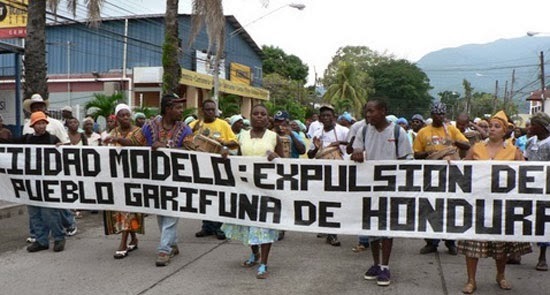
A new edition of e-flux, hot off the digital presses, hits us with some juicy morsels this month, including this text by Tyler Coburn, "Charter Citizen". Coburn tests the temperature of a recently ended radical libertarian venture - the establishment of autonomous cities within host country Honduras' borders - in order to reconceive capitalism anew.

"Charter Cities", Coburn explains, build off economist Paul Romer's theory that sets of carefully considered rules encourages economic growth, investment and innovation; and that introducing such "good rules" into a zone with weaker ones would encourage further economic and financial advancement within the host state, in investment, labour force and civil and political structures. But Coburn notes that the dominant and fundamental mode of political engagement at the grassroots level becomes movement - voluntary migration (both in and out) becomes political, democracy conditional and citizenship privatised; at an international level it becomes dependent on tenuously balanced comity and contract.
"Whether floating in international waters or sprouting on foreign territory, these proposed cities are the proving grounds for the technolibertarians’ foray into governance. In fact, they already demonstrate a concrete link between technology and geopolitics: venture capitalist Peter Thiel donated the same amount of startup funds to [charter city venture] the Seasteading Institute as to Facebook."
Also in this month's edition of e-flux online, available to non-subscribers, is a recent instalment by Reza Negarestani, whose work "Differential Cruelty" we spotlighted on BiM. Find these articles on the e-flux journal online.

30 January 2014

Book: Luke Bennett and Katja Hock, Scree


http://lukebennett13.wordpress.com/2013/11/11/scree-is-here/
 
In the tail end of 2013, Luke Bennett and Katja Hock released their collaborative effort Scree, currently available for download from Bennett's blog. Launching from an enquiry into an ordinary house brick sheltered in his garage, the pursuit to take it "back to the place of its birth" carry Bennett to peculiar wasteland places layered together in an accumulating escarpment: landfill, abandoned skiers' dry slope, forgotten gas works, ghost town and more.
"When I started out on this project I thought I'd be writing about the absence of the excavated matter, but the more I have searched for and peered into these 'holes' the more I have realised that what has happened here is the moving around of matter - across local space, across form and through time. Nothing has disappeared, it has just changed state or location."
Written in a self-identified psychogeographic style, Bennet and Hock's piece reads like a memoir replete with haunting images of space and memory. It includes, in the last handful of pages, a back-and-forth Q&A-style dialogue between Bennett and Hock ruminating on their different styles of approach to the project. The "'coffee-table' art book" can be downloaded as a pdf from here.

1 November 2013

Exhibitions: Aquatopia: The Imaginary of the Ocean Deep, Tate St Ives, 12 October 2013-26 January 2014 / Sound Versus System, Kunsthall Oslo, 19 October-21 December 2013

http://www.tate.org.uk/whats-on/tate-st-ives/exhibition/aquatopia
Juergen Teller, Björk, Spaghetti Nero, Venice (2007)
BiM spotlights two fascinating European exhibitions this week: Aquatopia: The Imaginary of the Ocean Deep, a major artistic retrospective on the vagueries of the sea, held at the Tate St Ives in Cornwall until 26 January; and Sound Versus System, a series of screenings, performances, talks and accompanying exhibition at the Kunsthall Oslo ending 21 December of this year.

The ambitious subject matter of the Tate St Ive's Aquatopia allows for an expansive coverage of aesthetic history. Fresh from the Nottingham Contemporary where it has resided for the past three months, the newly installed exhibition at the Tate St Ives (perfectly overlooking Porthmeor Beach) features works spanning from Katsushika Hokusai, J. M. W. Turner and Lucien Freud to Wangechi Mutu, Simon Starling and Marvin Gaye (Spartacus) Chetwynd, with many more between. Claiming that "Ocean myths both ancient and modern have been shaped by conquest and colonialism, and more recently by the tide of gender politics", it is perhaps unsurprising to find their printed catalogue brimming with not only literary excerpts but also essays from visual culture and historical theorists, writers, entertainers and more.

http://www.kunsthalloslo.no/?p=1303&lang=en
Drifting further north-east of Britain, Oslo's Kunsthall has its own busy schedule of events with Sound Versus System, featuring performances, talks screenings, art pieces and anything else that might "explore the potential of impure and hybrid forms, experimental relationships between sound and image, and the artistic disruption of both aesthetic and social structures".

The nine-week series of events and exhibition include the screening of a Norwegian film The Stone Wood Witches (1976) directed by Bredo Greve, which had been previously suppressed for being anti-proprietary and anti-Christian, as well as a major presentation of the forty-year oeuvre of experimental filmmaker Barbara Hammer. Besides this, expect numerous improvised concerts, films and sound pieces, and a cinematic selection by Kenneth Goldsmith gathered under the guiding principle: "Easy is the New Difficult: A Manifesto for a Non-resistant Art".

3 August 2013

Conference: Ordinary/Everyday/Quotidian, 26-7 September, York


Organisers for the two-day, interdisciplinary conference   "Ordinary/Everyday/Quotidian" at the University of York are currently calling for abstracts. The conference seeks to bring the quotidian onto the stage of academic debate and, by doing so, asks that we focus the rigors of critique upon the usually unnoticed or undetectable. Participants are encouraged
"to ponder, celebrate, and critique the quotidian, ranging from the furtive pleasures of pop to the dubious delights of junk: “Does it glow at the core with personal heat, with signs of one’s deepest nature, clues to secret yearnings, humiliating flaws? What habits, fetishes, addictions, inclinations? What solitary acts, behavioral ruts?”
The event has three confirmed keynotes - John Roberts (History of Art), Jennifer Baird (Classics and Archaeology) and Bryony Randall (English) - and will finish with a colloquium peopled by a further five academics from various humanities-based areas of study. With a keen interdisciplinary slant and compelling subject matter, the conference promises to provide a platform for some fascinating inquiry and dialogue.

Abstracts are due by 16 August and are welcome from any and/or multiple discipline(s). More information can be found on the website.

14 May 2013

Exhibition: A Journal of the Plague Year. Fear, ghosts, rebels. SARS, Leslie and the Hong Kong story, 16 May - 20 July 2013, Hong Kong

Lam Qua, Portrait no 48.Yang Kang, 1830-1850. Oil painting. Courtesy Yale University, Harvey Cushing/John Hay Whitney Medical Library.
Independent art space in Hong Kong, Para Site, explore the changing stories of a city in a new exhibition A Journal of the Plague Year. Fear, ghosts, rebels. SARS, Leslie and the Hong Kong story over the may to July period.

Showcasing an impressive list of internationally established talents and local artists, the exhibition threads its way through the "disparate though interconnected" visions and revisions of Hong Kong (places, spaces and people) in the wake of epidemic, economic and political instability and waves of human migration which occurred as a result of the SARS outbreak of 2003. Pathogenesis, politics and xenophobia meet the funereal and civic solidarity in strange combinations in this often overlooked tale of the last decade of Hong Kong.

"When the city became the epicenter of the most significant airborne epidemic in recent years - the SARS crisis of 2003 - the unparalleled shutdown of the city and the atomisation of society in quarantined segments lead to an unexpected shift in the political awareness of the Hong Kong citizenry. ... After that moment, the image of a de-politicised and soullessly pragmatic commercial hub could not anymore tell the whole story about Hong Kong."
As the contributors come from an array of professional backgrounds, including academics, journalism, film-making and the more creative arts, the responses to this quite challenging theme promises to be both varied and intriguing. A Journal of the Plague Year also includes two outdoor performances by Lygia Pape on 17 and 25 May. Check the Para Site website for further details.

27 March 2013

Performance & Exhibition: Ruth Clinton, Niamh Moriarty, Michael O'Rourke & Jeffrey Jerome Cohen, Rotator

Pallas Projects in Dublin city currently contains the collaborative exhibition by artists Ruth Clinton & Niamh Moriarty. The show, aptly coined with the palindrome Rotator, loops around secrets, crypts, water and topographies in a variety of media forms; it explores the lesser-known currents of one of the city's more familiar waterways (the River Poddle), records endless passageways of/in brick, and commemorates the hidden stories of the underground.
 
The rich textures of Clinton and Moriarty's exhibition - dizzingly wet, mossy and stony - are sensationally enlivened in a recorded "tour" of the exhibition performed by the artists themselves, Michael O'Rourke and Jeffrey Jerome Cohen (read by fellow artist John Ryan) on a wintery March evening. Beginning with an introduction by O'Rourke, the tour takes the form of a question-and-answer conversation between the participants inflected by the exhibition works. "Hydrocryptographic", O'Rourke describes Rotator, and the four performers draw upon Serres, Cixous, Derrida, myths of the giant Balor, Blake, T.S. Eliot and a particuarly savvy twenty-questions AI algorithm to trace the damp crevasses of the show within this 45 minute audio recording.
 
Audio of the tour can be found here. The exhibition catalogue is downloadable here. Further pictures and descriptions of the exhibition can be found in the artists' blog posts, Ruth Clinton and Niamh Moriarty as well as the Pallas Projects website, where may also be downloaded an information sheet related to Rotator and a podcast interview with the artists recorded by RTE Lyric FM.
"Rotator is more attuned to the inclinations and glossolalic streaming together of matter. The exhibition is an exercise in diverculvertation as we drift from territories of the infinitesimally small - our selves and bodily matter composed mostly of water - to the infinitely vast - rivers, seas, oceans, the sky, moon and stars."

28 February 2013

Radio Segment: This American Life, "Mapping", 4 September 1998


David Wood, map of the neighborhood’s phone, cable, and power lines
 Back in 1998, Radio program This American Life produced an hour-long segment entitled "Mapping", tracing five different techniques of mapping following the senses. The first twenty-four minutes are particularly interesting, involving interviews conducted with cartographer Denis Wood on his practices of mapping a myriad of different elements in his neighbourhood (from traffic signs to Halloween pumpkins - see a few examples here), and Toby Lester on his charting of ambient noises and drones produced by everyday machinery, both of which in some way seek to reinterpret one's expectations of cartographical practices.

These are followed by three stories, spanning the final thirty-four minutes of the bracket, which offer slightly flatter stories on the electronic nose developed by Cyrano Sciences (interesting when taken in context of the technology's further development over the past decade in various industrial sectors), on one woman's compulsive and hypochondriacal self-examinations of her body by touch, and on a food writer's mission in the 1980s to map all the eateries of Pico Boulevard in Los Angeles.

The stories can be streamed through the This American Life website as separate recordings or read in transcript form. 
"I'm looking at a map now that's got all of the overhead lines mapped on it, and it is a crazy star field. It's the power lines, the telephone lines, and the cable lines. And there's a hierarchy, of course. They flow into the neighborhood from outside the neighborhood. And as they move into individual homes, they break down. They shatter, so that the homes are all like the ends of little, teeny capillaries. ... It is a living organism."
Denis Wood

8 September 2012

Article: Valérie November, Eduardo Camacho-Hübner and Bruno Latour, "Entering a Risky Territory: Space in the Age of Digital Navigation"


Valérie November, Eduardo Camacho-Hübner and Bruno Latour argue for mapping reefs and risks in this call for a redefinition of cartographical interactions, "Entering a Risky Territory: Space in the Age of Digital Navigation", published in volume 28 of Environment and Planning D: Society and Space (2010) and now available online for free download.

Written almost as both rationale and prelude to work by the three authors on the mapping of risk, November, Camacho-Hübner and Latour here contend that the advent of accessible, interactive and user-defined digital mapping practices has the capacity to free us from a modernist, "mimetic" mapping impulse towards a more contingent, navigational interpretation. They argue that mimetic mapping, which relies on a spurious resemblance between representational map signs and a "real", outside territory, entrenches space and territory as part of a fixed and objective reality. Navigational practices, on the other hand, casts maps as "the dashboards of a calculation interface" for a succession of signposts via which movement can be negotiated. A shift towards navigational interpretation deeply implicates not only a freedom from "the tyranny of space" but also the inclusion of a whole set of "subjective" factors recognised in risk geography within practices of mapping.
"As soon as we shift to the navigational interpretation of geographical techniques, we realize that there is nothing especially spatial about geography. Any map is simply one set of inscriptions leading to and coming from another series of dissimilar signposts to help navigators find their way through their trajectories."
Environment and Planning D: Society and Space has recently included this work by November, Camacho-Hübner and Latour within a group of various "highlight" articles for open access availability. The articles, including, inter alia, a translated section of Michel Serres' Les origines de la géométrie, Graham Harman's "I am also of the opinion that materialism must be destroyed" and Michael Brown and Claire Rasmussen's "Bestiality and the Queering of the Human Animal", are accessible to nonsubscribers in order to provide an idea of the kinds of papers published in the journal.

3 July 2012

Lecture: Stuart Elden, "Secure the Volume: Vertical Geopolitics and the Depth of Power", Edinburgh, 5 July

Stuart Elden will be staying in Edinburgh for the Royal Geography Society Annual International Conference 2012, currently ongoing within the George Square area of the University of Edinburgh. His lecture, "Secure the Volume: Vertical Geopolitics and the Depth of Power", will take place from 5:20-7:00pm on 5 July in the Appleton Tower, Lecture Theatre 4. Elden's talk will traverse the literatures of vertical geopolitics and the work of Peter Sloterdijk in order to rethink the geopolitical implications of the third dimension.

"As Foucault suggests, 'the vertical is not one of the dimensions of space, it is the dimension of power'. The world does not just exist as a surface; security goes up and down; space is volumetric."

For further information concerning Elden's lecture can be found here. Further information concerning the conference can be found here.

20 June 2012

The Bodies in Movement Seminar Series presents Stuart Elden, 2 July, Edinburgh, 2-6pm


The Bodies in Movement Seminar Series, with the support of the Institute for Advanced Studies in the Humanities (IASH), is excited to present Stuart Elden, Professor in the Department of Geography at Durham University, as our third and last guest speaker for our Spring-Summer 2012 series of seminars. The afternoon seminar will take place on 2 July at IASH in Edinburgh.

Elden's challenging and interdisciplinary work in human geography and geopolitics has garnered him international recognition in a broad range of research fields. His present interests now turn towards Shakespearean geographies, "territory" and its definitional entanglements, and a critical revisioning of the forces at play in both text and territory when each informs the other. At this BiM Seminar, Elden turns a scrutinising eye on Coriolanus (the text and its recent 2011 cinematic counterpart starring Ralph Fiennes and Gerard Butler), then we open the floor to intimate discussion of his recent related work.

This is a free event, but booking is essential. Participants are asked to read the following texts in advance, which will be provided by the organisers upon confirmation of attendance:
  • "Land, Terrain, Territory." Progress in Human Geography 34.6: 799-817.
  • "The Geopolitics of King Lear: Territory, Land, Earth." Law and Literature 25 (forthcoming).

To secure a place at the seminar, please email one of the conference organisers. Further details on the BiM Seminar Series is available here.

Lena Wånggren (l.e.wanggren@sms.ed.ac.uk)
Kamillea Aghtan (kamillea@hotmail.com)
Karin Sellberg (k.j.k.sellberg@gmail.com)


Seminar Timetable

  • 2:00-2:15pm Introduction
  • 2:15-3:15pm Key Speaker
  • 3:15-3:45pm Tea and Coffee
  • 3:45-4:45pm Responses
  • 4:45-6:00pm Open Discussion  

Held at the Institute for Advanced Studies in the Humanities, 2 Hope Park Square, Edinburgh EH8 9NW.

12 December 2011

Article: Teddy Cruz, "Mapping Non-Conformity: Post-Bubble Urban Strategies"

The "Unsettling Visuality" issue (7.1) of bi-lingual English and Spanish visual arts journal e-Misférica comfortably houses amongst its various pieces on such subjects as Latin American visual culture, experimental neighbourhoods in Bogotá and Haitian tent geography, the article by urban architecture scholar Teddy Cruz, "Mapping Non-Conformity: Post-Bubble Urban Strategies". Using the malleable and thoroughly breached borders between San Diego and Tijuana as a complex case study, Cruz provides a forward-thinking commentary on the intersections between urban planning, the localisation of architectural creativity and designing space as political act.

Cruz travels between personal reflection (didactic and manifesto-esque, taking the suggestive format of numbered and italicised paragraphs as its opening and closing remarks), an absorbing narrative of movement which shift between and through these urban borders, and a situational analysis of four particular incidences of mobility which frustrates the strict demarcation of borders between these two spaces. In doing so, he strikes a refreshing balance between rational pluasibility and motivated revolutionism, and underlining this is the critical question: where can we find architectural practice (praxis)? His answer: in the "dismantling of the LARGE by pixilating it with the micro: an urbanism of retrofit", which requires, first and foremost, a re-evaluation of the geopolitics of jurisdiction and property.

"The linear rigidity of the artificial geopolitical boundary, which has 'flat-lined' the pulsations of the living complexity of the natural, is transformed back into a complex set of porous lines perpendicular to the border, as if they were small leakages that began to percolate through a dam...punctur[ing] the boderline in our fictional cartography..."
All the back issues of e-Misférica are also free to access online, as well as their current issue "Performance ≠ Life".

28 November 2011

Conference: Monstrous Geographies: Places and Spaces of Monstrosity, Oxford, 19-21 July 2012

A call for papers has recently been announced for the conference "Monstrous Geographies: Places and Spaces of Monstrosity", hosted at Mansfield College in Oxford on 19-21 July 2012. 

The event relates to one of eleven wider streams of an At the Interface Domain project on "Evil" seeking to critically engage with the influence and imagery of the monstrous on human culture, and with a particular emphasis on interdisciplinarity. The organising chairs are currently seeking 300-word proposals for papers, reports, works-in-progress, workshops and pre-formed panels on issues relating to an extensive range of themes which includes cosmographies, cartographies, landscapes, temporalities, and monsters on the move.
"What is the relationship between the monstrous and the geographic – those places monsters inhabit but also places that are configured as being monstrous in and of themselves? Places that engage notions of self and otherness, inclusion and exclusion, normal and aberrant, defense and contagion? ... These places raise diverse post-human quandaries regarding necessities in the present leading to real or imagined futures of humanity and habitation."
The organisers intend to release a volume of essays from selected conference papers, most likely joining the At the Interface/Probing the Boundaries series published by Rodopi and Inter-Disciplinary Press.