Showing posts with label Labour. Show all posts

9 February 2014

Article: Tyler Coburn, "Charter Citizen"

http://www.e-flux.com/journal/charter-citizen

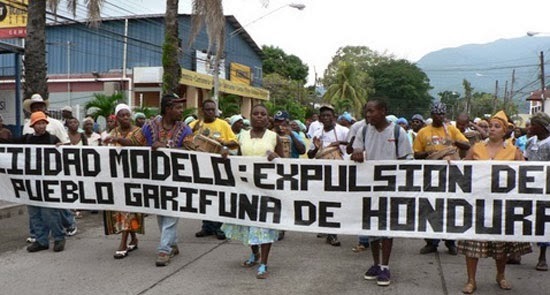
A new edition of e-flux, hot off the digital presses, hits us with some juicy morsels this month, including this text by Tyler Coburn, "Charter Citizen". Coburn tests the temperature of a recently ended radical libertarian venture - the establishment of autonomous cities within host country Honduras' borders - in order to reconceive capitalism anew.

"Charter Cities", Coburn explains, build off economist Paul Romer's theory that sets of carefully considered rules encourages economic growth, investment and innovation; and that introducing such "good rules" into a zone with weaker ones would encourage further economic and financial advancement within the host state, in investment, labour force and civil and political structures. But Coburn notes that the dominant and fundamental mode of political engagement at the grassroots level becomes movement - voluntary migration (both in and out) becomes political, democracy conditional and citizenship privatised; at an international level it becomes dependent on tenuously balanced comity and contract.
"Whether floating in international waters or sprouting on foreign territory, these proposed cities are the proving grounds for the technolibertarians’ foray into governance. In fact, they already demonstrate a concrete link between technology and geopolitics: venture capitalist Peter Thiel donated the same amount of startup funds to [charter city venture] the Seasteading Institute as to Facebook."
Also in this month's edition of e-flux online, available to non-subscribers, is a recent instalment by Reza Negarestani, whose work "Differential Cruelty" we spotlighted on BiM. Find these articles on the e-flux journal online.

23 January 2014

Conference & Exhibition: London Conference in Critical Thought 2014, 27-8 June, London / Simon Fugiwara, Rebekkah (Display), 29 January - 28 March, London

It's been a bit of a hectic, crazy end of year, signalled by a disappearance of updates for over a whopping two months. Having settled down a little now, Ky is happy to report that we're back in action (hopefully) and mean to bring you more constant updates of all things to do with corporeality, movement and theory in the coming 2014 year. For our watermark first post for 2014, the Bodies in Movement crowd happily present a couple of conference and art-related treasures.
 
 
http://londoncritical.org/
It's time again for the London Conference in Critical Thought for 2014, taking place this time at Goldsmiths, University of London. In its reliable fashion, the LCCT has aligned its stream areas to topics identified as carrying particular currency in the contemporary climate of critical theoretical engagement. The political and legal seem prominent this year, along with various strains of critical pedagogy. A full stream listing can be found on their website.
 
Stream proposals are now closed, but their call for papers stays open for submissions until 10 March 2014. Participation is completely free, which offers a nice incentive, but registration is mandatory.
 
 
http://www.contemporaryartsociety.org/event/displays-simon-fujiwara/Also in London, 59 Central Street Displays run by the Contemporary Art Society will feature Simon Fujiwara's Rebekkah, featuring 100 terracotta female soldiers modelled after a 16 year old girl from Hackney (predictably named Rebekkah) who was arrested for her participation in the 2011 London Riots. Rebekkah is the material product of a social experiment involving Rebekkah and Fujiwara, of which more can be read here. 
"Up to 100 figures were created in [an] assembly line technique, shifting Rebekkah to a new position: a representative of a new breed of British-born warrior and a soldier for social change."
Fujiwara will be at the Contemporary Art Society at 7pm on 30 January to talk about his piece. The event is sold out but they are accepting names to their waiting list. Further information can be found here.

20 November 2013

Conference: Accelerationism: A Symposium on Tendencies in Capitalism, 14 December, Berlin

http://xlrt.org/
"Though encaged within cognitive capitalism, we call for an epistemic acceleration. The symposium convenes to refresh the cartography of the keywords employed in the last centuries to describe economy and the political response to it: development, progress, growth, accumulation, peak, degrowth, revolution, speculation, entropy, singularity, sustainability and so on. Today it is time to anticipate and accelerate, for sure, time for anastrophism and not catastrophism."

 
With the publication of Nick Srnicek and Alex Williams' #Accelerate Manifesto for an Accelerationist Politics kicking up a Twitter storm halfway through this year (and with international beauty brand Aesop marking the arrival of their seasonal gift kits branded "A Futurist Assembly" with a new interpretation of the Futurists' manifesto), who could resist this compelling call to arms announced on the site for Accelerationism: A Symposium on Tendencies in Capitalism?

The event, which takes place in Berlin on 14 December of this year, features a host of names familiar to conversations on accelerationism - Ray Brassier, Josephine Berry Slater, Benjamin Noys, Elisabeth von Samsonow, Srnicek and Williams. Participation is free for those able to attend but the conference organisers require an RSVP via Facebook. With almost 300 registered, Accelerationism is bound to be a highly populated event.

7 November 2013

Article: Maria-Daniella Dick and Robbie McLaughlan, "The Desire Network"

http://www.ctheory.net/articles.aspx?id=727#_ednref1
With Twitter hitting Wall Street hard yesterday and bouncing twice as high as any rubber ball stuffed with money, it seems appropriate to showcase one of the newer contributions to CTheory's Theory Beyond the Codes: Maria-Daniella Dick and Robbie McLaughlan's "The Desire Network". Casting their eye on Facebook, the authors conduct an intelligent theoretical and political examination of the Zuckerberg effect, which has "largely passed without any thorough critical analysis" through the same academy that saw its inception and disseminated it.
 
While perhaps touting the flag of rhizomatic relations, Dick and McLaughlan argue that in fact this angel of social networking phenomena not only represents but constitutes the ideology of a kind of liberal democracy predicated on the reshaping of desire as a process of perpetual production and, consequently, on a mutated capitalistic machine.
"...the truly revolutionary aspect of social networking is not how knowledge has become privatised, but the revolution that it has instigated in the way in which being now functions within this era of cyber-entrepreneurialism; this ontological shift effects, we argue, a correlative mutation in the function of desire which, in turn, effects a mutation in capitalism."
A "neurotic" portrait of Facebook's workings includes an analysis of David Fincher's 2010 film The Social Network, a quick cameo of Sean Duffy, and (more substantially) a compelling description of Facebook's enactment of the endless deferral of the real. What the authors somewhat chillingly conclude in their psychoanalytic sketch is a model in which "desire becomes its own network", endlessly producing without object or exit.
 
"The Desire Network" is available online at ctheory.net. While there, take some time to check out their new offerings, including Jussi Parikka's interesting "Dust and Exhaustion: The Labor of Media Materialism".

14 May 2013

Exhibition: A Journal of the Plague Year. Fear, ghosts, rebels. SARS, Leslie and the Hong Kong story, 16 May - 20 July 2013, Hong Kong

Lam Qua, Portrait no 48.Yang Kang, 1830-1850. Oil painting. Courtesy Yale University, Harvey Cushing/John Hay Whitney Medical Library.
Independent art space in Hong Kong, Para Site, explore the changing stories of a city in a new exhibition A Journal of the Plague Year. Fear, ghosts, rebels. SARS, Leslie and the Hong Kong story over the may to July period.

Showcasing an impressive list of internationally established talents and local artists, the exhibition threads its way through the "disparate though interconnected" visions and revisions of Hong Kong (places, spaces and people) in the wake of epidemic, economic and political instability and waves of human migration which occurred as a result of the SARS outbreak of 2003. Pathogenesis, politics and xenophobia meet the funereal and civic solidarity in strange combinations in this often overlooked tale of the last decade of Hong Kong.

"When the city became the epicenter of the most significant airborne epidemic in recent years - the SARS crisis of 2003 - the unparalleled shutdown of the city and the atomisation of society in quarantined segments lead to an unexpected shift in the political awareness of the Hong Kong citizenry. ... After that moment, the image of a de-politicised and soullessly pragmatic commercial hub could not anymore tell the whole story about Hong Kong."
As the contributors come from an array of professional backgrounds, including academics, journalism, film-making and the more creative arts, the responses to this quite challenging theme promises to be both varied and intriguing. A Journal of the Plague Year also includes two outdoor performances by Lygia Pape on 17 and 25 May. Check the Para Site website for further details.

20 April 2013

Recorded Lecture: McKenzie Wark, "Telesthesia: How Class and Power Work in the Post-Internet Age"

One of Google's data centers, photographed by Connie Zhou.
McKenzie Wark prods at our understandings of class and social relations with this half-hour video recording, "Telesthesia: How Class and Power Work in the Post-Internet Age", presented at the Art, Technology, and Culture Lecture Series hosted by the University of Berkeley's Center for New Media on 19 December 2012.

Extracted from his recent book Telesthesia: Communication, Culture and Class (published by Polity in the tail end of last year), Wark offers us an intriguing snapshot at his thesis on the current "vectoral age". Tracing vectoral strategies from the deployment of military force at a distance, to creative reappropriation of spaces and information, and the tactics of growth deployed by rising Fortune 500 corporations such as Google and Apple, Wark proposes that in this post-internet age and "overdeveloped" (first) world, we have entered a third stage of commodity culture - beyond pastoralism and capitalism - of information ruled and managed by the vector. And as the concept of property becomes more abstract, he asserts that the vectoral class now unseats the capitalist in power and dominance.
"The vector becomes much more flexible, elaborate, refined in its flows of data. It is nowhere necessary to cluster related parts of the production process physically near one another. The vector opens the way to a spatial disaggregation of production. It isn't the multitude who fled the scene, it was capital." 
The lecture can be viewed at Archive.org, where various other Art, Technology, and Culture lectures can also be viewed and/or heard, kindly provided by the Berkeley Center for New Media.

1 December 2012

Exhibition: "BUSY. Exhausted Self / Unlimited Ability", 20 September 2012 - 13 January 2013, Vienna

Cosima von Bonin, "The Bonin / Oswald Empire's Nothing #04" (2010)

21er Haus at the Österreichische Galerie Belvedere houses "BUSY. Exhuasted Self / Unlimited Ability", an exhibition which critically responds to the changes in human relations to labour economies, replacing the "role conflicts and schizophrenia" symptomatic of hierarchical, industrial society with "stress, depression, and burn out" which characterises information capital.
 
Curator Bettina Steinbrügge adapts the idea of Cosima Rainer in cooperation with the Academy of Fine Arts in Vienna to provide this comment on work, precarity, artistic process and the valuation of time. The pieces selected for this show springboard from the always "busy", work-time and life amalgamation in contemporary culture and the resulting disappearance of time itself. As contributing artist Manfred Erjautz comments in a slick podcast of interviews of those involved, "We've got enough time anyway - we only handle it the wrong way".
"Art was once the utopian counter model to achievement-oriented and other-directed gainful employment, a realm of freedom opposing the realm of necessities. Today, it has developed before our eyes to a model for a mobile and autonomous “Ich-AG,” or “Me-inc.,“ to the ideal of project-related work."

5 August 2012

Book: Carl Cederström & Peter Fleming, Dead Man Working

 
Dead Man Working by Carl Cederström and Peter Fleming is a new addition to the Zer0 Books series of long, "intellectual without being academic" essays on contemporary culture attempting to bring intellectual critique back to the public. Published in May 2012, this almost pocket-sized book offers an absorbing jeremiad on the economies of labour, time and selves within the all-consuming stricture of work-as-life.

Dead Man Working postulates that a neoliberal biopolitical management of the worker now occupies the corpse of captialism, which insists that not merely our bodies and time but the whole of our lives are organised and structured by the single operative mode of work. Cederström and Fleming's discursive examination cycles from call centre sweatshop to brothel special services and banker suicides (casually via Gilles Deleuze, The Smiths, Andy Warhol and many others) to expose a bleak world of inescapable labour and industry wherein not even death offers an effective exit strategy. 
"If work was once primarily regulated by bureaucracy through depersonalization then today we witness the emergence of a new regime of control which we call biocracy, in which life itself is an essential 'human resource' to be exploited ... Work is now presented as the Siamese twin to life, as the sphere in which life can most fully thrive." (14)
Those curious about Dead Man Working may also find Ivor Southwood's tract, Non-Stop Inertia (another Zer0 Books publication), which offers a complementary analysis of contemporary labour conditions and precarious life, worth a perusal.

6 May 2011

Book: Ivor Southwood, Non-Stop Inertia

In this short but sweet scrutiny of labour management structures in Britain published by Zero Books in 2011, Ivor Southwood's semi-autobiographical critique pulls what could have been a standard macroscopic analysis of employment systems, production pressures and precarious work into an intimate, microscopic commentary on the production of a world of precarious workers.

Sometimes diatribe but constantly engrossing,
the text maps an insidious culture of workstyle transience extending into the level of lifestyle organisation. Through the plethora of fascinating analyses on such experiences as the precariousness of temp work, jobseeking as a career, and technologies which insist upon obligatory availability, Southwood compiles these and the production of their corresponding anxieties as evidence in exposing a society's cultish obsession with perpetuating a disconcerting but nonetheless normalised state of "non-stop inertia".


"Beneath the veneer of lifestyle choices, in reality most people cannot afford to accept or reject particular jobs according to their own ethical preferences or pursue outside interests which are not strictly 'goal-oriented'. ... Such preoccupations divert attention away from wider abstract social or political concerns and onto a continual anxious self-surveillance. This constant precariousness and restless mobility, compounded by a dependence upon relentlessly updating market-driven technology and scrolling CGI of digital media, together suggest a sort of cultural stagflation, a population revving up without getting anywhere. The result is a kind of frenetic inactivity: we are caught in a cycle of non-stop inertia." (11)