"in the sense of being in pursuit of nature's consequences. We invite perspectives on critique, science, ecology, technology and subjectivity as bound up with conceptions of nature and experiments with various positions in contemporary thought."Confirmed plenary speakers currently include eminent figures Françoise Balibar, Rahel Jaeggi, Mark B. N. Hansen and (most enviably for this reporter) Michel Serres. Abstracts are due by 17 May 2014, which leaves plenty of time to produce presentation and panel proposals. The conference website currently lacks content, but the CFP can be found at the Society for European Philosophy website. Academics, graduate students and independent scholars are all welcome to submit.
Showing posts with label Cities. Show all posts
24 February 2014
Conference: Philosophy after Nature, 3-5 September, Utrecht
Labels:
Biology,
Cities,
Conference,
Ecology,
Ontology,
Senses,
Technology,
Time
9 February 2014
Article: Tyler Coburn, "Charter Citizen"
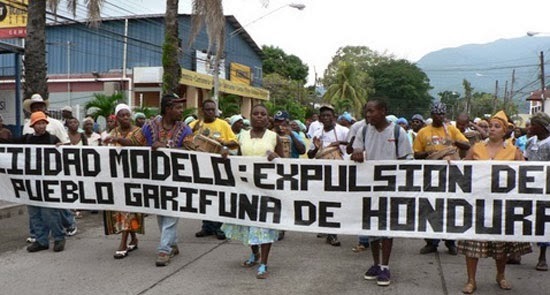
A new edition of e-flux, hot off the digital presses, hits us with some juicy morsels this month, including this text by Tyler Coburn, "Charter Citizen". Coburn tests the temperature of a recently ended radical libertarian venture - the establishment of autonomous cities within host country Honduras' borders - in order to reconceive capitalism anew.
"Charter Cities", Coburn explains, build off economist Paul Romer's theory that sets of carefully considered rules encourages economic growth, investment and innovation; and that introducing such "good rules" into a zone with weaker ones would encourage further economic and financial advancement within the host state, in investment, labour force and civil and political structures. But Coburn notes that the dominant and fundamental mode of political engagement at the grassroots level becomes movement - voluntary migration (both in and out) becomes political, democracy conditional and citizenship privatised; at an international level it becomes dependent on tenuously balanced comity and contract.
"Whether floating in international waters or sprouting on foreign territory, these proposed cities are the proving grounds for the technolibertarians’ foray into governance. In fact, they already demonstrate a concrete link between technology and geopolitics: venture capitalist Peter Thiel donated the same amount of startup funds to [charter city venture] the Seasteading Institute as to Facebook."
24 August 2013
Article: Liz Kinnamon, "London Riots, Living Walls: Questions of Resistance in Late Capitalism"
![]() |
| Street Art vs. Capitalism by Escif in Grottaglie, Italy, 2011 |
A lucid break-down of the consumerist atmosphere of the UK riots follows, and a surprisingly complementary reading with the officially-sanctioned graffiti happenings staged during the Living Walls conference. Kinnamon paints a sad picture of the blunted and sanitised evolution of these anti-authoritarian practices since the 1970s:
"We are fully planted in a time when resistance is co-opted, folded into capital, and rendered harmless. ... But even before someone trademarks and stamps a slogan from the latest peoples movement onto a t-shirt, many so-called rebellions bear an already-resemblance to the systems they allegedly oppose. The actors in the UK riots and Living Walls utilize and exhibit the same characteristics capitalist governmentality has conditioned in them."Yet hope is not completely lost: Kinnamon leaves us with some space to salvage these modes of political speech (rioting, graffiti) from their integration into capital through the work of Rei Terada via Michel Foucault's concept of parrhesia. However, the forms which these speech acts adopt, it would seem, will always be precarious and ambivalent at best.
Rhizomes is an open-access journal. All the essays in the current issue are all freely downloadable from their website. Its archive is also worth a lengthy browse; it can be found here.
14 May 2013
Exhibition: A Journal of the Plague Year. Fear, ghosts, rebels. SARS, Leslie and the Hong Kong story, 16 May - 20 July 2013, Hong Kong
![]() |
| Lam Qua, Portrait no 48.Yang Kang, 1830-1850. Oil painting. Courtesy Yale University, Harvey Cushing/John Hay Whitney Medical Library. |
Showcasing an impressive list of internationally established talents and local artists, the exhibition threads its way through the "disparate though interconnected" visions and revisions of Hong Kong (places, spaces and people) in the wake of epidemic, economic and political instability and waves of human migration which occurred as a result of the SARS outbreak of 2003. Pathogenesis, politics and xenophobia meet the funereal and civic solidarity in strange combinations in this often overlooked tale of the last decade of Hong Kong.
"When the city became the epicenter of the most significant airborne epidemic in recent years - the SARS crisis of 2003 - the unparalleled shutdown of the city and the atomisation of society in quarantined segments lead to an unexpected shift in the political awareness of the Hong Kong citizenry. ... After that moment, the image of a de-politicised and soullessly pragmatic commercial hub could not anymore tell the whole story about Hong Kong."
Labels:
Cities,
Exhibition,
Geography,
Health,
Labour,
Performance
Subscribe to:
Posts (Atom)