Showing posts with label Capital. Show all posts

19 February 2014

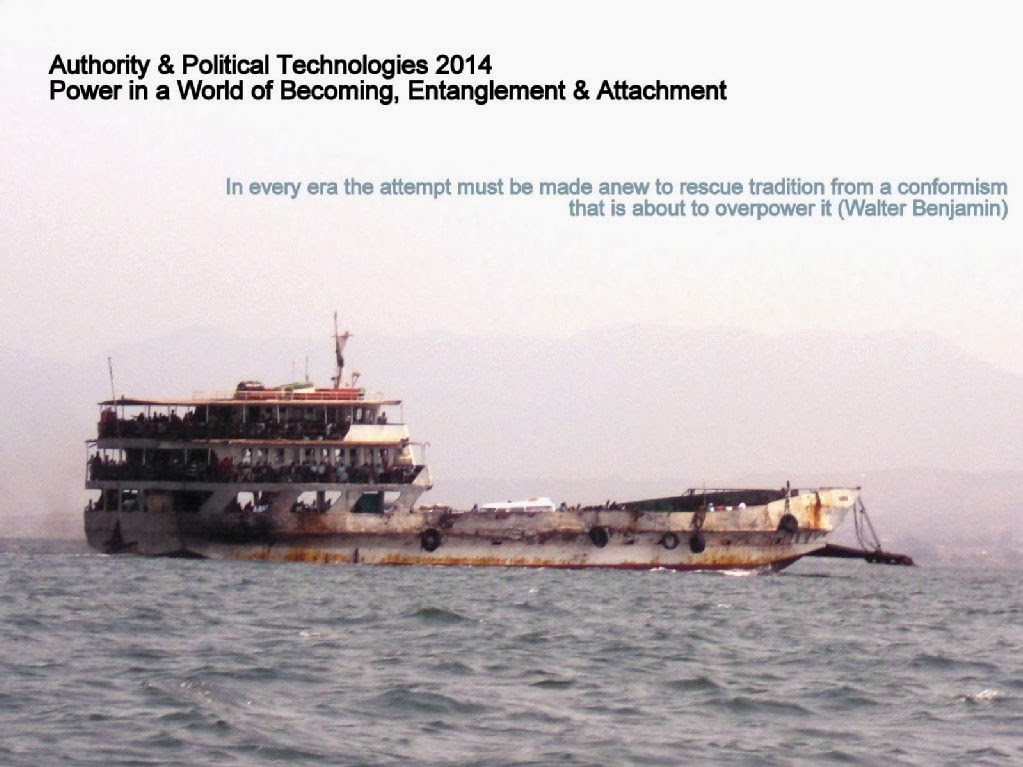
Conference: Authority & Political Technologies 2014, 2-3 June, Warwick

http://www2.warwick.ac.uk/fac/soc/sociology/rsw/authorityandpoliticaltechnologies/apt2014/Recently announced conference event "Authority & Political Technologies 2014: Power in a World of Becoming, Entanglement & Attachment" is aiming for a reinvigoration of post-structuralist theory at its intersection with the social sciences in early June this year at the University of Warwick. The Institute for Advanced Study gives this intriguing statement of intention:
"the issues that post-structuralist theory placed on the critical social science agenda have become more vital than ever - be that the concern for the complex and dispersed nature of power and agency; the imbrication of power and economics with knowledge and science; rethinking the relation between equality and difference; the political/contested/changing nature of embodiment, biology and ecology; or the efforts of states and others to establish and exercise power over life itself. We maintain that now is the time, not to reject post-structuralist perspectives, but to reinvigorate and transform those traditions through empirical and political work that is creatively engaged with current problems."

No less ambitiously, the conference promises a thrillingly line-up of excellent keynote speakers - Louise Armoore, William Connolly, Christian Borch, Costas Douzinas, Amade M'charek, Luciana Parisi and AbdouMaliq Simone - which guarantees provocative discussion on the conference topics from diverse academic perspectives within the humanities.

Abstract submission is open until 10 March, with suggested themes raging from biopolitics and religion to necropolitics and authority. Further information can be found on the conference website along with the online abstract submission form.

9 February 2014

Article: Tyler Coburn, "Charter Citizen"

http://www.e-flux.com/journal/charter-citizen

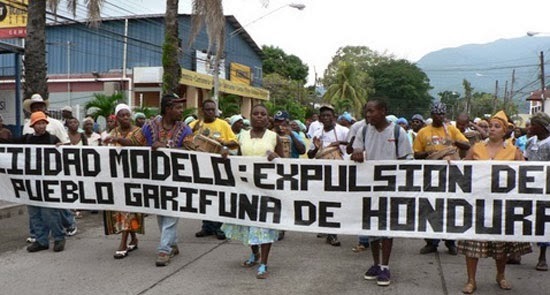
A new edition of e-flux, hot off the digital presses, hits us with some juicy morsels this month, including this text by Tyler Coburn, "Charter Citizen". Coburn tests the temperature of a recently ended radical libertarian venture - the establishment of autonomous cities within host country Honduras' borders - in order to reconceive capitalism anew.

"Charter Cities", Coburn explains, build off economist Paul Romer's theory that sets of carefully considered rules encourages economic growth, investment and innovation; and that introducing such "good rules" into a zone with weaker ones would encourage further economic and financial advancement within the host state, in investment, labour force and civil and political structures. But Coburn notes that the dominant and fundamental mode of political engagement at the grassroots level becomes movement - voluntary migration (both in and out) becomes political, democracy conditional and citizenship privatised; at an international level it becomes dependent on tenuously balanced comity and contract.
"Whether floating in international waters or sprouting on foreign territory, these proposed cities are the proving grounds for the technolibertarians’ foray into governance. In fact, they already demonstrate a concrete link between technology and geopolitics: venture capitalist Peter Thiel donated the same amount of startup funds to [charter city venture] the Seasteading Institute as to Facebook."
Also in this month's edition of e-flux online, available to non-subscribers, is a recent instalment by Reza Negarestani, whose work "Differential Cruelty" we spotlighted on BiM. Find these articles on the e-flux journal online.

20 November 2013

Conference: Accelerationism: A Symposium on Tendencies in Capitalism, 14 December, Berlin

http://xlrt.org/
"Though encaged within cognitive capitalism, we call for an epistemic acceleration. The symposium convenes to refresh the cartography of the keywords employed in the last centuries to describe economy and the political response to it: development, progress, growth, accumulation, peak, degrowth, revolution, speculation, entropy, singularity, sustainability and so on. Today it is time to anticipate and accelerate, for sure, time for anastrophism and not catastrophism."

 
With the publication of Nick Srnicek and Alex Williams' #Accelerate Manifesto for an Accelerationist Politics kicking up a Twitter storm halfway through this year (and with international beauty brand Aesop marking the arrival of their seasonal gift kits branded "A Futurist Assembly" with a new interpretation of the Futurists' manifesto), who could resist this compelling call to arms announced on the site for Accelerationism: A Symposium on Tendencies in Capitalism?

The event, which takes place in Berlin on 14 December of this year, features a host of names familiar to conversations on accelerationism - Ray Brassier, Josephine Berry Slater, Benjamin Noys, Elisabeth von Samsonow, Srnicek and Williams. Participation is free for those able to attend but the conference organisers require an RSVP via Facebook. With almost 300 registered, Accelerationism is bound to be a highly populated event.

7 November 2013

Article: Maria-Daniella Dick and Robbie McLaughlan, "The Desire Network"

http://www.ctheory.net/articles.aspx?id=727#_ednref1
With Twitter hitting Wall Street hard yesterday and bouncing twice as high as any rubber ball stuffed with money, it seems appropriate to showcase one of the newer contributions to CTheory's Theory Beyond the Codes: Maria-Daniella Dick and Robbie McLaughlan's "The Desire Network". Casting their eye on Facebook, the authors conduct an intelligent theoretical and political examination of the Zuckerberg effect, which has "largely passed without any thorough critical analysis" through the same academy that saw its inception and disseminated it.
 
While perhaps touting the flag of rhizomatic relations, Dick and McLaughlan argue that in fact this angel of social networking phenomena not only represents but constitutes the ideology of a kind of liberal democracy predicated on the reshaping of desire as a process of perpetual production and, consequently, on a mutated capitalistic machine.
"...the truly revolutionary aspect of social networking is not how knowledge has become privatised, but the revolution that it has instigated in the way in which being now functions within this era of cyber-entrepreneurialism; this ontological shift effects, we argue, a correlative mutation in the function of desire which, in turn, effects a mutation in capitalism."
A "neurotic" portrait of Facebook's workings includes an analysis of David Fincher's 2010 film The Social Network, a quick cameo of Sean Duffy, and (more substantially) a compelling description of Facebook's enactment of the endless deferral of the real. What the authors somewhat chillingly conclude in their psychoanalytic sketch is a model in which "desire becomes its own network", endlessly producing without object or exit.
 
"The Desire Network" is available online at ctheory.net. While there, take some time to check out their new offerings, including Jussi Parikka's interesting "Dust and Exhaustion: The Labor of Media Materialism".

24 August 2013

Article: Liz Kinnamon, "London Riots, Living Walls: Questions of Resistance in Late Capitalism"

Street Art vs. Capitalism by Escif in Grottaglie, Italy, 2011
Deleuzian-inspired e-journal Rhizomes dedicates the virtual pages of its most recent 2013 issue (no. 25) to the cultural and political potential of graffiti, where amongst its offerings (varying a little in quality and glowing exaltation of street art's potential) nestles Liz Kinnamon's incisive commentary, "London Riots, Living Walls: Questions of Resistance in Late Capitalism". Critically investigating the revolutionary potential of graffiti and rioting practices as political speech acts, Kinnamon takes two temporally proximate events in 2011 - the street art conference in Atlanta, Living Walls: The City Speaks and the riots across the ocean in the United Kingdom - to explore the loaded question: "In a neoliberal capitalist climate ... where capital is continuously, cannibalistically folding in, what becomes of attempts to find a way out?"

A lucid break-down of the consumerist atmosphere of the UK riots follows, and a surprisingly complementary reading with the officially-sanctioned graffiti happenings staged during the Living Walls conference. Kinnamon paints a sad picture of the blunted and sanitised evolution of these anti-authoritarian practices since the 1970s:
"We are fully planted in a time when resistance is co-opted, folded into capital, and rendered harmless. ... But even before someone trademarks and stamps a slogan from the latest peoples movement onto a t-shirt, many so-called rebellions bear an already-resemblance to the systems they allegedly oppose. The actors in the UK riots and Living Walls utilize and exhibit the same characteristics capitalist governmentality has conditioned in them."
Yet hope is not completely lost: Kinnamon leaves us with some space to salvage these modes of political speech (rioting, graffiti) from their integration into capital through the work of Rei Terada via Michel Foucault's concept of parrhesia. However, the forms which these speech acts adopt, it would seem, will always be precarious and ambivalent at best.

Rhizomes is an open-access journal. All the essays in the current issue are all freely downloadable from their website. Its archive is also worth a lengthy browse; it can be found here.

17 August 2013

Conference: Touring Consumption 2013, 24-5 October, Karlsruhe


Karlsruhe provides the opportunity to talk critically about tourism, tourist practices and traversing spaces in October of this year at the "Touring Consumption 2013" conference hosted by Karlshochschule International University. Embracing an expansive notion of mobilities and travel, the conference aims to "confront spatial, performative and cultural interrelations between tourism and social/economic behaviour"  in order to discuss the complexities which might be involved in concepts of "touring consumption".

The call for papers for Touring Consumption 2013 have closed but registration is still available on their website. It will feature around thirty speakers, some interactive workshops and a "surprise tour", along with three keynote speakers: prolific academic in mobilities and theories of tourism John Urry, human geographer Jørgen Ole Bærenholdt and sociologist Steve Miles, all of whom closely engage with cultures and theories of consumption in their critical writings.

For further details on the conference outlines, refer to the website. Co-organiser of the conference Desmond Wee has also been interviewed by Patrick Breitenbach on a Karlsdialoge podcast (found here), in which he talks about his approach to tourism analysis generally, suntan lotion, fake beaches, couch-surfing and AirBnB, as well as the conference aims and a handful of other related subjects.

"... one of the things this conference tries to do is to look at the notion of practice: how tourism is practiced; how it moves; how we look at flows of information; flows of people. ... It's about representations also, but it's how representations evolved ... How ideas are co-produced and reproduced; how new meanings emerge. This conference tries to put that in perspective, and [investigate] how different spaces are being consumed."

20 April 2013

Recorded Lecture: McKenzie Wark, "Telesthesia: How Class and Power Work in the Post-Internet Age"

One of Google's data centers, photographed by Connie Zhou.
McKenzie Wark prods at our understandings of class and social relations with this half-hour video recording, "Telesthesia: How Class and Power Work in the Post-Internet Age", presented at the Art, Technology, and Culture Lecture Series hosted by the University of Berkeley's Center for New Media on 19 December 2012.

Extracted from his recent book Telesthesia: Communication, Culture and Class (published by Polity in the tail end of last year), Wark offers us an intriguing snapshot at his thesis on the current "vectoral age". Tracing vectoral strategies from the deployment of military force at a distance, to creative reappropriation of spaces and information, and the tactics of growth deployed by rising Fortune 500 corporations such as Google and Apple, Wark proposes that in this post-internet age and "overdeveloped" (first) world, we have entered a third stage of commodity culture - beyond pastoralism and capitalism - of information ruled and managed by the vector. And as the concept of property becomes more abstract, he asserts that the vectoral class now unseats the capitalist in power and dominance.
"The vector becomes much more flexible, elaborate, refined in its flows of data. It is nowhere necessary to cluster related parts of the production process physically near one another. The vector opens the way to a spatial disaggregation of production. It isn't the multitude who fled the scene, it was capital." 
The lecture can be viewed at Archive.org, where various other Art, Technology, and Culture lectures can also be viewed and/or heard, kindly provided by the Berkeley Center for New Media.