Showing posts with label Politics. Show all posts

19 February 2014

Conference: Authority & Political Technologies 2014, 2-3 June, Warwick

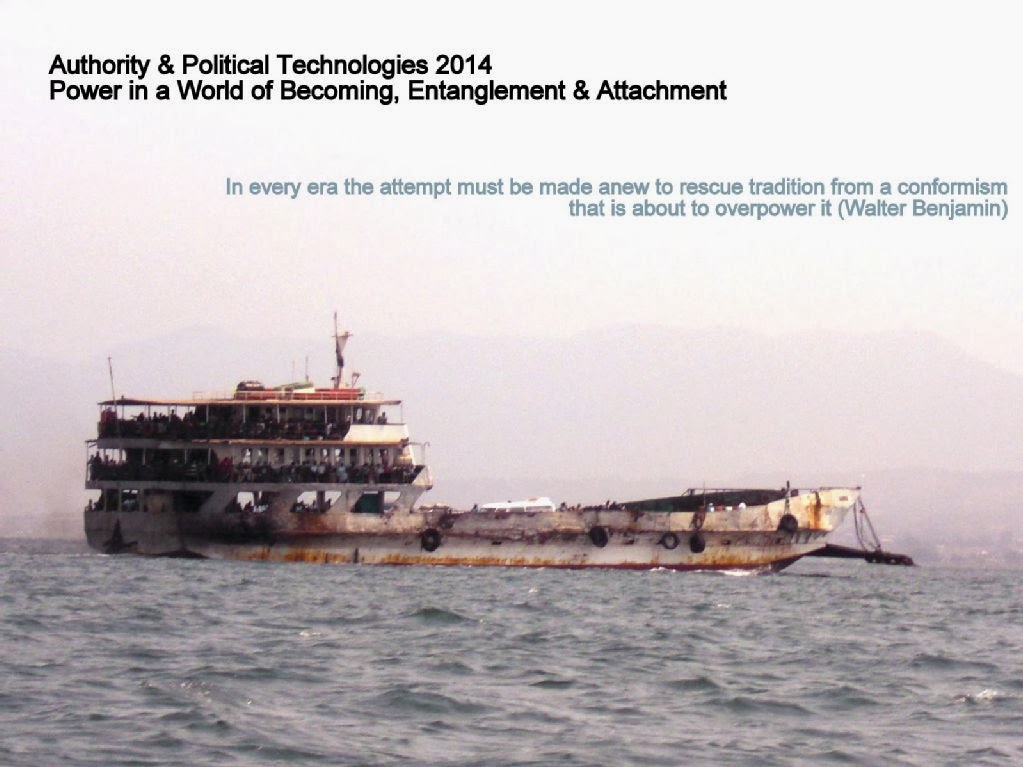
http://www2.warwick.ac.uk/fac/soc/sociology/rsw/authorityandpoliticaltechnologies/apt2014/Recently announced conference event "Authority & Political Technologies 2014: Power in a World of Becoming, Entanglement & Attachment" is aiming for a reinvigoration of post-structuralist theory at its intersection with the social sciences in early June this year at the University of Warwick. The Institute for Advanced Study gives this intriguing statement of intention:
"the issues that post-structuralist theory placed on the critical social science agenda have become more vital than ever - be that the concern for the complex and dispersed nature of power and agency; the imbrication of power and economics with knowledge and science; rethinking the relation between equality and difference; the political/contested/changing nature of embodiment, biology and ecology; or the efforts of states and others to establish and exercise power over life itself. We maintain that now is the time, not to reject post-structuralist perspectives, but to reinvigorate and transform those traditions through empirical and political work that is creatively engaged with current problems."

No less ambitiously, the conference promises a thrillingly line-up of excellent keynote speakers - Louise Armoore, William Connolly, Christian Borch, Costas Douzinas, Amade M'charek, Luciana Parisi and AbdouMaliq Simone - which guarantees provocative discussion on the conference topics from diverse academic perspectives within the humanities.

Abstract submission is open until 10 March, with suggested themes raging from biopolitics and religion to necropolitics and authority. Further information can be found on the conference website along with the online abstract submission form.

9 February 2014

Article: Tyler Coburn, "Charter Citizen"

http://www.e-flux.com/journal/charter-citizen

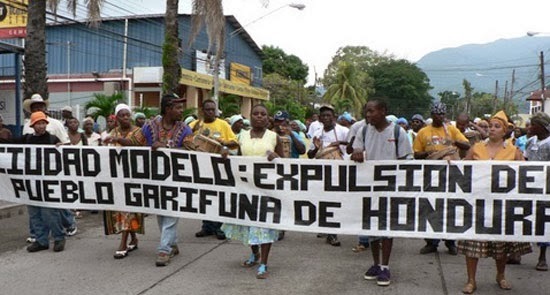
A new edition of e-flux, hot off the digital presses, hits us with some juicy morsels this month, including this text by Tyler Coburn, "Charter Citizen". Coburn tests the temperature of a recently ended radical libertarian venture - the establishment of autonomous cities within host country Honduras' borders - in order to reconceive capitalism anew.

"Charter Cities", Coburn explains, build off economist Paul Romer's theory that sets of carefully considered rules encourages economic growth, investment and innovation; and that introducing such "good rules" into a zone with weaker ones would encourage further economic and financial advancement within the host state, in investment, labour force and civil and political structures. But Coburn notes that the dominant and fundamental mode of political engagement at the grassroots level becomes movement - voluntary migration (both in and out) becomes political, democracy conditional and citizenship privatised; at an international level it becomes dependent on tenuously balanced comity and contract.
"Whether floating in international waters or sprouting on foreign territory, these proposed cities are the proving grounds for the technolibertarians’ foray into governance. In fact, they already demonstrate a concrete link between technology and geopolitics: venture capitalist Peter Thiel donated the same amount of startup funds to [charter city venture] the Seasteading Institute as to Facebook."
Also in this month's edition of e-flux online, available to non-subscribers, is a recent instalment by Reza Negarestani, whose work "Differential Cruelty" we spotlighted on BiM. Find these articles on the e-flux journal online.

23 January 2014

Conference & Exhibition: London Conference in Critical Thought 2014, 27-8 June, London / Simon Fugiwara, Rebekkah (Display), 29 January - 28 March, London

It's been a bit of a hectic, crazy end of year, signalled by a disappearance of updates for over a whopping two months. Having settled down a little now, Ky is happy to report that we're back in action (hopefully) and mean to bring you more constant updates of all things to do with corporeality, movement and theory in the coming 2014 year. For our watermark first post for 2014, the Bodies in Movement crowd happily present a couple of conference and art-related treasures.
 
 
http://londoncritical.org/
It's time again for the London Conference in Critical Thought for 2014, taking place this time at Goldsmiths, University of London. In its reliable fashion, the LCCT has aligned its stream areas to topics identified as carrying particular currency in the contemporary climate of critical theoretical engagement. The political and legal seem prominent this year, along with various strains of critical pedagogy. A full stream listing can be found on their website.
 
Stream proposals are now closed, but their call for papers stays open for submissions until 10 March 2014. Participation is completely free, which offers a nice incentive, but registration is mandatory.
 
 
http://www.contemporaryartsociety.org/event/displays-simon-fujiwara/Also in London, 59 Central Street Displays run by the Contemporary Art Society will feature Simon Fujiwara's Rebekkah, featuring 100 terracotta female soldiers modelled after a 16 year old girl from Hackney (predictably named Rebekkah) who was arrested for her participation in the 2011 London Riots. Rebekkah is the material product of a social experiment involving Rebekkah and Fujiwara, of which more can be read here. 
"Up to 100 figures were created in [an] assembly line technique, shifting Rebekkah to a new position: a representative of a new breed of British-born warrior and a soldier for social change."
Fujiwara will be at the Contemporary Art Society at 7pm on 30 January to talk about his piece. The event is sold out but they are accepting names to their waiting list. Further information can be found here.

20 November 2013

Conference: Accelerationism: A Symposium on Tendencies in Capitalism, 14 December, Berlin

http://xlrt.org/
"Though encaged within cognitive capitalism, we call for an epistemic acceleration. The symposium convenes to refresh the cartography of the keywords employed in the last centuries to describe economy and the political response to it: development, progress, growth, accumulation, peak, degrowth, revolution, speculation, entropy, singularity, sustainability and so on. Today it is time to anticipate and accelerate, for sure, time for anastrophism and not catastrophism."

 
With the publication of Nick Srnicek and Alex Williams' #Accelerate Manifesto for an Accelerationist Politics kicking up a Twitter storm halfway through this year (and with international beauty brand Aesop marking the arrival of their seasonal gift kits branded "A Futurist Assembly" with a new interpretation of the Futurists' manifesto), who could resist this compelling call to arms announced on the site for Accelerationism: A Symposium on Tendencies in Capitalism?

The event, which takes place in Berlin on 14 December of this year, features a host of names familiar to conversations on accelerationism - Ray Brassier, Josephine Berry Slater, Benjamin Noys, Elisabeth von Samsonow, Srnicek and Williams. Participation is free for those able to attend but the conference organisers require an RSVP via Facebook. With almost 300 registered, Accelerationism is bound to be a highly populated event.

7 November 2013

Article: Maria-Daniella Dick and Robbie McLaughlan, "The Desire Network"

http://www.ctheory.net/articles.aspx?id=727#_ednref1
With Twitter hitting Wall Street hard yesterday and bouncing twice as high as any rubber ball stuffed with money, it seems appropriate to showcase one of the newer contributions to CTheory's Theory Beyond the Codes: Maria-Daniella Dick and Robbie McLaughlan's "The Desire Network". Casting their eye on Facebook, the authors conduct an intelligent theoretical and political examination of the Zuckerberg effect, which has "largely passed without any thorough critical analysis" through the same academy that saw its inception and disseminated it.
 
While perhaps touting the flag of rhizomatic relations, Dick and McLaughlan argue that in fact this angel of social networking phenomena not only represents but constitutes the ideology of a kind of liberal democracy predicated on the reshaping of desire as a process of perpetual production and, consequently, on a mutated capitalistic machine.
"...the truly revolutionary aspect of social networking is not how knowledge has become privatised, but the revolution that it has instigated in the way in which being now functions within this era of cyber-entrepreneurialism; this ontological shift effects, we argue, a correlative mutation in the function of desire which, in turn, effects a mutation in capitalism."
A "neurotic" portrait of Facebook's workings includes an analysis of David Fincher's 2010 film The Social Network, a quick cameo of Sean Duffy, and (more substantially) a compelling description of Facebook's enactment of the endless deferral of the real. What the authors somewhat chillingly conclude in their psychoanalytic sketch is a model in which "desire becomes its own network", endlessly producing without object or exit.
 
"The Desire Network" is available online at ctheory.net. While there, take some time to check out their new offerings, including Jussi Parikka's interesting "Dust and Exhaustion: The Labor of Media Materialism".

25 September 2013

Article: Steve Redhead, "This Statism We're In"

Sports media, subculture and accelerated culture theorist Steve Redhead takes a bite at British politics as a microcosm of current Western political tendencies in his digestible mini-report, "This Statism We're In".

Launching from claims of neoliberalism's death after the global financial crisis, Redhead argues that the state is now positioned as a crucial, albeit somewhat silent, actor in British policy frameworks:
"the reframing of the state’s role pervades all efforts to move beyond the contemporary laissez-faire philosophy and the dominance of the free market. ... [I]t is more than market versus state, more than market individualism versus state collectivism: it turns, radically, on perspectives on statism, anti-statism and all positions in between, 'Statism', and all of the conflict over the state and its extent, form and role, is a central battleground in this debate. 'Left' equated with statism and 'right' associated with libertarianism is a false dichotomy."
Upon entering such a stage of scrutiny, the question of role of the state unbalances those previously-assumed dichotomised positions we had once taken for granted; no longer left/right, liberal/authoritarian, minimal/big, positions now proliferate British government which challenge the political chequer board, encapsulating multiple seemingly antithetical ideologies. What is the state? Redhead comes to no conclusions, but posits that in the wake of current 'revisioning', what it means to theorise, critique and evaluate is also due for some serious reconsideration.

"This Statism We're In" can be found on Steve Redhead's website, at which can be found other small reports by this single-person think-tank. Topics include musings on Paul Virilio and Jean Baudrillard, politics and sports fanaticism.

24 August 2013

Article: Liz Kinnamon, "London Riots, Living Walls: Questions of Resistance in Late Capitalism"

Street Art vs. Capitalism by Escif in Grottaglie, Italy, 2011
Deleuzian-inspired e-journal Rhizomes dedicates the virtual pages of its most recent 2013 issue (no. 25) to the cultural and political potential of graffiti, where amongst its offerings (varying a little in quality and glowing exaltation of street art's potential) nestles Liz Kinnamon's incisive commentary, "London Riots, Living Walls: Questions of Resistance in Late Capitalism". Critically investigating the revolutionary potential of graffiti and rioting practices as political speech acts, Kinnamon takes two temporally proximate events in 2011 - the street art conference in Atlanta, Living Walls: The City Speaks and the riots across the ocean in the United Kingdom - to explore the loaded question: "In a neoliberal capitalist climate ... where capital is continuously, cannibalistically folding in, what becomes of attempts to find a way out?"

A lucid break-down of the consumerist atmosphere of the UK riots follows, and a surprisingly complementary reading with the officially-sanctioned graffiti happenings staged during the Living Walls conference. Kinnamon paints a sad picture of the blunted and sanitised evolution of these anti-authoritarian practices since the 1970s:
"We are fully planted in a time when resistance is co-opted, folded into capital, and rendered harmless. ... But even before someone trademarks and stamps a slogan from the latest peoples movement onto a t-shirt, many so-called rebellions bear an already-resemblance to the systems they allegedly oppose. The actors in the UK riots and Living Walls utilize and exhibit the same characteristics capitalist governmentality has conditioned in them."
Yet hope is not completely lost: Kinnamon leaves us with some space to salvage these modes of political speech (rioting, graffiti) from their integration into capital through the work of Rei Terada via Michel Foucault's concept of parrhesia. However, the forms which these speech acts adopt, it would seem, will always be precarious and ambivalent at best.

Rhizomes is an open-access journal. All the essays in the current issue are all freely downloadable from their website. Its archive is also worth a lengthy browse; it can be found here.

3 August 2013

Conference: Ordinary/Everyday/Quotidian, 26-7 September, York


Organisers for the two-day, interdisciplinary conference   "Ordinary/Everyday/Quotidian" at the University of York are currently calling for abstracts. The conference seeks to bring the quotidian onto the stage of academic debate and, by doing so, asks that we focus the rigors of critique upon the usually unnoticed or undetectable. Participants are encouraged
"to ponder, celebrate, and critique the quotidian, ranging from the furtive pleasures of pop to the dubious delights of junk: “Does it glow at the core with personal heat, with signs of one’s deepest nature, clues to secret yearnings, humiliating flaws? What habits, fetishes, addictions, inclinations? What solitary acts, behavioral ruts?”
The event has three confirmed keynotes - John Roberts (History of Art), Jennifer Baird (Classics and Archaeology) and Bryony Randall (English) - and will finish with a colloquium peopled by a further five academics from various humanities-based areas of study. With a keen interdisciplinary slant and compelling subject matter, the conference promises to provide a platform for some fascinating inquiry and dialogue.

Abstracts are due by 16 August and are welcome from any and/or multiple discipline(s). More information can be found on the website.

26 July 2013

Conference: A Feeling for Things - Jane Bennett, 4-5 October, London


Birkbeck (University of London) offers
another fantastic two-day event in early October, "A Feeling for Things: A Conversation around the work of Jane Bennett". The evening of 4 October will feature a public lecture by Jane Bennett, some of whose work we have already featured on this blog here and here. This will be followed by a full-day workshop on 5 October. Drawing upon academics from a variety of backgrounds - Eileen
Joy, João Florêncio, Jussi Parikka, Nigel Clark, Milla Tiainen, Lisa Baraitser and Michael O’Rourke - the event promises to be both a fascinating conversation between politics and philosophy, and a likely crowd-puller.

The public lecture will offer insight into Bennett's current research. The workshop on 5 October seeks to investigate the possible resonances and feedback between the politics of Bennett's work and a variety of other disciplines:
"This two day event makes the writing of Jane Bennett a vibrant matter for discussion across the fields of philosophy, psychosocial studies, political theory, cultural studies, literary theory, visual theory and performance studies among others. In particular, the focus will be on how Bennett’s explorations of vitalism, anthropocentrism, agency, biopolitics and new materialisms contribute to the emerging and fraught conversations between feminist and queer theory, Object Oriented Ontology and Speculative Realism."
Registration to the workshop on 5 October costs £20 for students and Birkbeck staff, £40 for all other attendees, with attendance at the public lecture mandatory for all workshop participants. Links to registration are provided on the event webpage. The public lecture on 4 October is free but booking is required - registration to this is handled through Eventbrite.

21 July 2013

Recorded Lecture: Costas Douzinas, "Philosophy and the Right to Revolution"

 
Listen to Costas Douzinas offer a friendly challenge to Slavoj Žižek and Alain Badiou in terms of the right to revolution and its lawfulness in this lecture, "Philosophy and the Right to Revolution" (although bearing the slightly modified name on the Backdoor Broadcasting Company where it is archived), recorded in London during the two-day conference Actuality of the Absolute: Hegel, Our Untimely Contemporary. Deviating from Žižek, who adds a few of his own comments from the audience, Douzinas' self-branded "heretical" politics asserts a reading of Hegel, disobedience and the Athens riots of 2008 (to name a few themes) in order to posit and explore the right to revolution.
 
Douzinas scrolls conceptually through "the normative force of the real" - through which previous law is negated in the face of successful revolution (and the criminal rebellion is found to be always already authorised) - before moving on to a close reading of property and subjectivity within Hegel, revolution and crime as motors for legal adjustment, and the right to socio-political rebellion based on necessity.
"The revolution does not just delete the past, it synchronically creates its own conditions of success. ... Fact and law, revolution and right, are closely intertwined. The time arrow is reversed. In this sense, every rebellion is, and will have been, the exercise to the right of revolution. Right and revolution, instead of being antithetical, are coeval, supporting each other."
Other contributors to the Actuality of the Absolute conference include Žižek and previous BiM Seminar guest Catherine Malabou. Find their and other fascinating presentations archived on the Backdoor Broadcasting Company here.

29 April 2013

Article: Bojana Cvejić, Marta Popivoda, Ana Vujanović and Bruno Latour, "A Conversation with Bruno Latour"

Making Things Public exhibition. Photo by Franz Wamhof.
Interviewers Bojana Cvejić, Marta Popivoda and Ana Vujanović delve into performance theory, politics and the public in this short interview with Bruno Latour, conducted at the end of 2011 and published in the most recent number of open-access TkH Journal for Performing Arts Theory (No. 20, 2012), devoted to the theme of Art and the Public Good.

Springboarding off the theoretical conceptions of the public posited by Walter Lippmann and John Dewey, Latour, Cvejić, Popivoda and Vujanović explore the difficulties of performing (in) a political moment, the disappearance of politics and fumbling in the dark, with a fleeting touch upon Latour's co-curated exhibition Making Things Public from 2005 (in the catalogue for which he produced the call-to-arms for an object-oriented democracy, "From Realpolitik to Dingpolitik"). Departing from a public/private divide in favour of recognising politics as located at that place of exception "where experts fail, where ... there is no procedure in place", Latour examines the sensitivities implicit in public and political actions.
"I can name the exact moment when it happened, when I started doing this ephemeral work of building a strange circle whereby you obtain something that is absolutely imposible: to speak in the name of several different people who say different things. And no habit can accomplish that. That's exceptional and if the principle of exception has an ephemeral quality to it, that's also what makes political activities hard."
No. 20 of ThK also includes a piece by Nina Power, which explores the London riots, the "public" and the legal status of art (this works through themes brought up in her public lecture of May 2012 blogged here) and a biting inquisition by Mario KikaÅ¡ into the failures of the critical theory sanctioned by the university, along with other short pieces exploring the various intricacies of performance theory, politics and the public. The next issue should be published soon this year.

20 April 2013

Recorded Lecture: McKenzie Wark, "Telesthesia: How Class and Power Work in the Post-Internet Age"

One of Google's data centers, photographed by Connie Zhou.
McKenzie Wark prods at our understandings of class and social relations with this half-hour video recording, "Telesthesia: How Class and Power Work in the Post-Internet Age", presented at the Art, Technology, and Culture Lecture Series hosted by the University of Berkeley's Center for New Media on 19 December 2012.

Extracted from his recent book Telesthesia: Communication, Culture and Class (published by Polity in the tail end of last year), Wark offers us an intriguing snapshot at his thesis on the current "vectoral age". Tracing vectoral strategies from the deployment of military force at a distance, to creative reappropriation of spaces and information, and the tactics of growth deployed by rising Fortune 500 corporations such as Google and Apple, Wark proposes that in this post-internet age and "overdeveloped" (first) world, we have entered a third stage of commodity culture - beyond pastoralism and capitalism - of information ruled and managed by the vector. And as the concept of property becomes more abstract, he asserts that the vectoral class now unseats the capitalist in power and dominance.
"The vector becomes much more flexible, elaborate, refined in its flows of data. It is nowhere necessary to cluster related parts of the production process physically near one another. The vector opens the way to a spatial disaggregation of production. It isn't the multitude who fled the scene, it was capital." 
The lecture can be viewed at Archive.org, where various other Art, Technology, and Culture lectures can also be viewed and/or heard, kindly provided by the Berkeley Center for New Media.

14 April 2013

Conference: Matter, Life and Resistance, 1-2 July 2013, Canterbury

The Centre for Critical Thought at the University of Kent in Canterbury has announced a two-day conference entitled Matter, Life and Resistance, taking place in Canterbury on 1-2 July 2013. Located within the general field of political theory, the event seeks to explore the crossover, feedback and influence (both historically and in current trends) of theories of materialism, vitalism and resistance within the discipline. The lineup of keynote speakers features Samantha Frost, whose work engages with the body, biology, feminism and new materialisms; and Sjoerd van Tuinen, prolific scholar specialising on Deleuze and Sloterdijk.
 
Proposals are still wanted, with suggested areas for contributions including, inter alia: reinterpreting the history of political thought, particularly the seventeenth- and eighteenth-century materialists; connecting a poststructuralist conceptualisation of of life, matter and resistance with biology and the neurosciences (ontogenesis, transductive relations, plasticity, synaptogenesis); and the consequences of speculative materialism in political theory. The deadline for abstracts is set for 5 May 2013. More details can be found on the Matter, Life and Resistance conference blog.

6 January 2013

Recorded Lecture: William Connolly, "Freedom, Creativity and Teleodynamism"


Over 30 November to 1 December of 2012, the "Between Deleuze and Foucault" project at Purdue University held a conference which brought together project collaborators to discuss the implications of Deleuze's reading of Foucault. Fortunately, for those unable to attend the conference, video recordings have been made of nearly all the contributions are are currently available to watch from the project website.

Within the conference program, William Connolly features as plenary speaker with his paper, "Freedom, Creativity and Teleodynamism", which he describes as an experiement "between Foucault and Deleuze ... and not only Neitzche but Whitehead". Connolly ambitiously explores the complexities of "creativity" by way of Whitehead as well as biologist and neurologist Terrence Deacon, attending particularly to Deacon's concept of "teleodynamic activity" - a kind of ends-directed and consequence-oriented organisational creativity based on a reciprocal relation to environmental changes and proximities. Within such teleodynamic processes, he argues that new and unplanned formations sometimes emerge from encounters between and within organisms in periodic, positive creativity.

By carefully interlacing this concept of teledynamic process within a reading of Nietzsche's drives of the self (with close attention to the text Daybreak) and Foucault's tactics of the self, Connolly takes an experiemental bite into a vast feld of meaty topics, including but certainly not limited to those of incipience, powers of the false and (briefly) the dangers of creativity and moves towards its quarantine.
"Incompleteness and time-out-of-joint now lose their melancholy standing as mere lacks or losses. They regain them as both dangerous and as uncertain conditions of possibility for positive creativity..."

3 July 2012

Lecture: Stuart Elden, "Secure the Volume: Vertical Geopolitics and the Depth of Power", Edinburgh, 5 July

Stuart Elden will be staying in Edinburgh for the Royal Geography Society Annual International Conference 2012, currently ongoing within the George Square area of the University of Edinburgh. His lecture, "Secure the Volume: Vertical Geopolitics and the Depth of Power", will take place from 5:20-7:00pm on 5 July in the Appleton Tower, Lecture Theatre 4. Elden's talk will traverse the literatures of vertical geopolitics and the work of Peter Sloterdijk in order to rethink the geopolitical implications of the third dimension.

"As Foucault suggests, 'the vertical is not one of the dimensions of space, it is the dimension of power'. The world does not just exist as a surface; security goes up and down; space is volumetric."

For further information concerning Elden's lecture can be found here. Further information concerning the conference can be found here.

20 June 2012

The Bodies in Movement Seminar Series presents Stuart Elden, 2 July, Edinburgh, 2-6pm


The Bodies in Movement Seminar Series, with the support of the Institute for Advanced Studies in the Humanities (IASH), is excited to present Stuart Elden, Professor in the Department of Geography at Durham University, as our third and last guest speaker for our Spring-Summer 2012 series of seminars. The afternoon seminar will take place on 2 July at IASH in Edinburgh.

Elden's challenging and interdisciplinary work in human geography and geopolitics has garnered him international recognition in a broad range of research fields. His present interests now turn towards Shakespearean geographies, "territory" and its definitional entanglements, and a critical revisioning of the forces at play in both text and territory when each informs the other. At this BiM Seminar, Elden turns a scrutinising eye on Coriolanus (the text and its recent 2011 cinematic counterpart starring Ralph Fiennes and Gerard Butler), then we open the floor to intimate discussion of his recent related work.

This is a free event, but booking is essential. Participants are asked to read the following texts in advance, which will be provided by the organisers upon confirmation of attendance:
  • "Land, Terrain, Territory." Progress in Human Geography 34.6: 799-817.
  • "The Geopolitics of King Lear: Territory, Land, Earth." Law and Literature 25 (forthcoming).

To secure a place at the seminar, please email one of the conference organisers. Further details on the BiM Seminar Series is available here.

Lena WÃ¥nggren (l.e.wanggren@sms.ed.ac.uk)
Kamillea Aghtan (kamillea@hotmail.com)
Karin Sellberg (k.j.k.sellberg@gmail.com)


Seminar Timetable

  • 2:00-2:15pm Introduction
  • 2:15-3:15pm Key Speaker
  • 3:15-3:45pm Tea and Coffee
  • 3:45-4:45pm Responses
  • 4:45-6:00pm Open Discussion  

Held at the Institute for Advanced Studies in the Humanities, 2 Hope Park Square, Edinburgh EH8 9NW.

12 May 2012

Recorded Lecture: Nina Power, "The Spectre of the 'Public': The Ideology of Law and Order"

The Backdoor Broadcasting Company has archived a probing, half-hour talk by Nina Power, presented as part of the Ideology Now Conference at the Birkbeck Institute for the Humanities in London on 28 April 2012. Getting messy in the heavy topics of law and the public in the "creative empiricism" of Britain's politico-legal environment, Power casts an analytical eye upon the legal and lingusitic formulation of the public and the legal subject in light of Britain's past year of riots, protests and "public disturbance".

Her discursive, engaging and conversational presentation begins from the question: "Why don't we know anything about the law?" Reassessing Louis Althusser's descriptions of the law as belonging to both the repressive state apparatus and ideological state apparatuses, and of the figure of the individual as the bourgeois ideological subject, Power examines what happens when the law confronts (or refuses to confront) collective subjects and group activity.

Power's talk teases out two kinds of legally-recognised publics, a disruptive "bad public" and an always silent and absent "good public". It is on behalf of this good public, constantly terrified of the potentially misbehaving mass of the self-organised mob, that the law and judiciary is "endlessly aggrieved". It is also on behalf of this "good public" that the law is obliged to carve out each component individual from the unsanctioned "bad public",  so as to persecute every member as representatives of an unacceptable collective. Power states:

"With the ongoing and perhaps almost complete destruction of the public sphere in the name of privatisation, individualism and competition, we are at the same time confronted with the necessary ghost of the acceptable public, the one invoked by the state in the name of the preservation of order. This is the mute, static public used against the mobile, protesting public."

25 April 2012

Conference: Poetics of Anxiety and Security: the problem of speech and action in our time. Homi Bhabha on Auden and Arendt, London, 27-8 April 2012

In a two-day conference hosted by Birkbeck (University of London) and the Serpentine Gallery on 27-28 April of this year, Homi Bhabha will lead what will no doubt be a challenging and completely absorbing discussion on W. H. Auden's The Age of Anxiety and Hannah Arendt oeuvre.

Due to its popularity, the venue of the conference has been shifted and as a result further places are available for reservation through the Birkbeck website. Kicking off with a performances, readings and a keyote by Homi Bhabha on the evening on the first day, this will be followed by another keynote and a fairly scholarly schedule of speakers on the second day. And, best of all, the event is free of charge.
"participants will investigate ... in particular the links between the works, the relevance of poetry and the wider issue of security. This multi-disciplinary event will include lectures, discussions, screenings, poetry readings and performances to examine essential questions about the relationship between poetry, politics and art."

17 March 2012

Conferences: Dis-Placing the East/West Binary, Cardiff, 2 November 2012; and Sensualising Deformity, Edinburgh, 15-16 June 2012 (program)


The Centre for Interdisciplinary Film and Visual Culture Research at Cardiff University plays host to the one-day international symposium, Dis-Placing the East/West Binary: Aesthetic and Cultural Crossover in Film and Visual Culture at the tail end of this year. Taking place over the course of a full day from 10am to 6pm on 2 November 2012, the symposium examines and interrogates "contemporary displacements and transformations of relations between East Asian and Euro-American film and visual culture", with an emphasis on exploring the loaded concept of "place" in East/West visual culture.

The event features a keynote from Jane Chi Hyun Park, whose book, Yellow Future: Oriental Style in Hollywood Cinema was published by University of Minnesota Press in 2010. The organiser is currently inviting presentation proposals for the event.


On a slightly different note, the Edinburgh-based conference Sensualisng Deformity: Communication and Construction of Monstrous Embodiment (which we blogged about before) has now released their provisional programme, packed with a full schedule of talks and with keynotes by Margrit Shildrick, Rosemarie Garland-Thomson, Peter Hutchings and Jeffrey Jerome Cohen.

18 February 2012

Conference: London Conference in Critical Thought 2012, London, 29-30 June 2012


The London Conference in Critical Thought host their inaugural conference on 29-30 June of this year, supported by the Birkbeck Institute for the Humanities. Engaging with the "critical" tradition, the LCCT is especially seeking out those who fall within the fringes and margins of their academic disciplines in the humanities and social sciences to share their work within a collaborative, interdisciplinary setting.

The conference is divided into sixteen streams (and one catchall, "general" stream), which focus on, inter alia, law and culture, objects and time, Deleuze, animality, cosmopolitics, critiquing critical theory and the ethics of radical politics. Further stream descriptions can be found on their website.
"The LCCT aims to provide an opportunity for those who frequently find themselves at the margins of their department or discipline to engage with other scholars who share theoretical approaches and interests. Interdisciplinary and inter-institutional, the conference hopes to foster emergent critical thought and provide new avenues for critically orientated scholarship and collaboration."
Held at Birkbeck College (University of London), the conference is free to all participants. Their call for papers and panels ends on 19 February, so those interested should send in their proposals very soon.